Thursday, May 30, 2019

Rajiv Gandhi killing: SC dismisses plea against convicts' release (Tamil Nadu)

09 MAY 2019 Last Updated at 7:12 PM | SOURCE: IANS

The Supreme Court on Thursday dismissed the plea by families of those killed along with former Prime Minister Rajiv Gandhi by a LTTE suicide bomber at Tamil Nadu's Sriperumbudur on May 21, 1991, opposing the release of the seven remaining convicts in the case.

A bench, headed by Chief Justice Ranjan Gogoi, said: "All aspects were covered in the earlier constitution bench verdict in the case and, therefore, nothing survives in the case. In view of the above, the writ petition stands disposed of." As an outcome of the apex court's decision, Tamil Nadu Governor Banwarilal Purohit will take a decision regarding freeing the seven convicts held guilty in the assassination of the former PM and 16 others. On September 9, 2018, the Tamil Nadu Cabinet passed an order recommending the release of the convicts but the issue has been pending before the Governor, who is yet to take any decision, as the petition of the victims' families was pending in the top court.

When in 2014, the then Chief Minister J Jayalalithaa decided to free the convicts, who have already been in jail for 28 years after the apex court commuted their death sentences to life imprisonment, K. Ramasugandam, John Joseph, R. Mala, M. Samuvel Diraviyam, America V. Narayanan and S. Abbas filed a petition against it in the apex court. Senior advocates Gopal Sankaranarayanan and Prabu Ramasubramanium, representing A.G. Perarivalan, who is one of the seven convicts, brought the CJI's attention to the victims' petition pending in the top court since 2014. They also argued that none of the convicts were ever made parties in the case, despite that their lives were directly linked, and as a consequence, the petition has become infructuous.

Agreeing with the argument, the court said: "Having considered the matter, we are of the view that no live issue remains for adjudication in view of the Constitution Bench judgement of this court." A five-judge Constitution bench, headed by then Chief Justice H.L. Dattu, had in 2015 upheld Centre's right to decide, on the remission of sentence of life convicts, specifically where the case was investigated by the Centre. It then allowed the three-judge bench to give the final word on the case. Sankaranarayanan contended the three-judge bench had already closed the case, and as a consequence, there is simply nothing left in the top court and the court agreed.

Following these verdicts in 2015, the Tamil Nadu government had written to the Centre in March 2016 proposing remission of sentence of these convicts as it expected the Centre would be in harmony on this issue. But, in April 2018, the Centre refused to budge from its previous stand opposing the release, saying the crime was unparalleled in the history of the country. The apex court took an opposite stand to the Centre in September 2018, and asked the Tamil Nadu Governor to decide the fate of the convicts.

Man gets life sentence for killing wife, father-in-law (Maharashtra)

08 MAY 2019 Last Updated at 11:12 PM | SOURCE: PTI

Mumbai, May 8 A city court Wednesday awarded life sentence to a man for murdering his wife and father-in- law over monetary issue in 2013.

During his deposition, a police official said he was on patrol duty in October 2013 when he came to know about the double murder in Sakinaka area of suburban Andheri. The official said when he reached the spot near a housing society, he found two bodies lying in a pool of blood. According to the prosecution, the president of the housing society told police the bodies were of Nilesh Kamble's wife Saraswati and his father-in-law Mahadev Lokhande.

The housing society president, a key witness in the case, had told the court that after committing the crime, Kamble called him saying he had killed both of them. The key witness told the court the convict had further revealed that his father-in-law was demanding Rs 70,000 from him, which led to a fight between them. During the scuffle, Kamble attacked his father-in-law with a knife and then his wife when she tried to intervene, leading to the death of the duo, the prosecution said. AVI RSY NSD NSD

Solitary Confinement Of Death Convict Prior To Rejection Of Mercy Petition Palpably Illegal: SC

BY: ASHOK KINI2 May 2019 8:41 AM 

"On receipt of a mercy petition, the Department concerned has to call for all the records and materials connected with the conviction." 

The Supreme Court has observed that solitary confinement of a person sentenced to death prior to the rejection of mercy petition is palpably illegal. The bench comprising Justice NV Ramana, Justice Mohan M. Shantanagoudar and Justice S. Abdul Nazeer upheld the Punjab and Haryana High Court judgment that had commuted death sentence awarded to a murder accused whose mercy petition was rejected by the President of India in 2013.

The Death sentence awarded to Dharam Pal, in a murder case, was affirmed by the Supreme Court in the year 1999. His petition seeking pardon, filed in 1999, was rejected by the President in the year 2013. The Punjab and Haryana High Court allowed his writ petition and commuted the death sentence to life imprisonment in light of the change in circumstances- his acquittal in the rape case, which was an important deciding factor by this Court in negating his appeal and delay in deciding his mercy petition by the President, among other ground.

Solitary Confinement Of Death Convict Prior To Rejection Of Mercy Petition Palpably Illegal: SC [Read Judgment]
Justice NV Ramana, Justice Mohan M. Shantanagoudar and Justice S. Abdul Nazeer 
Convict cannot be said to be "under sentence of death" till the mercy petition is rejected.
In this proceeding, the centre admitted that Dharam Pal remained in solitary confinement for a period of 18 years, and has undergone imprisonment for a total period of more than 25 years till date. Referring to Sunil Batra judgment, the bench observed that even if the Sessions Court has sentenced the convict to death, subject to the confirmation of the High Court, or even if the appeal is filed before the High Court and the Supreme Court against the imposition of death punishment and the same is pending, the convict cannot be said to be "under sentence of death" till the mercy petition filed before the Governor or the President is rejected. 

In this regard, the bench observed: 
"Throughout the period of deciding his mercy petition by the President, he was kept in solitary confinement in various jails. Solitary confinement prior to the disposal of the mercy petition is per se illegal and amounts to separate and additional punishment not authorized by law… …. Thus, solitary confinement prior to the rejection of mercy petition, which has taken place in spite of various decisions of this Court to the contrary, is unfortunate and palpably illegal. In the present case, the Respondent underwent such a long period of solitary confinement that too, prior to his mercy petition being rejected, thereby making it a formidable case for commuting his death sentence into life imprisonment, as rightly held by the High Court" 
Prolonged Delay In Execution Of Death Sentence Violates Fundamental Right
The court also upheld the High Court observation that the prolonged delay in execution of a sentence of death has a dehumanizing effect and this has the constitutional implication of depriving a person of his life in an unjust, unfair and unreasonable way so as to offend the fundamental right under Article 21 of the Constitution. 

All Relevant Materials Should Be Placed Before President While He Considers Mercy Petition
The bench further observed that the fact that he was subsequently acquitted in the rape case (SC while confirming his death sentence had taken note of the conviction by Trial Court) has great bearing on the quantum on sentence that ought to be awarded to him and the same should have been brought to the notice of the President while deciding his mercy petition.
On receipt of a mercy petition, the Department concerned has to call for all the records and materials connected with the conviction. When the matter is placed before the President, it is incumbent on the part of the concerned authority to place all the materials such as judgments of the courts, as well as any other relevant material connected with the conviction. 
The bench, taking into account all circumstances, finally directed his release after the completion of 35 years of actual imprisonment including the period already undergone by him.

HC sends death penalty ruling back to trial court (Maharashtra)

Mumbai, Apr 25, 2019

Three years after a Thane court awarded death penalty to a man for raping and murdering a 7-year-old girl, the Bombay High Court Thursday remanded the case back to it on account of procedural lapses.

A bench of justices B P Dharmadhikari and P D Naik set aside the trial court's order awarding Atul Rama Lote death penalty Thursday. It remanded the case back to the trial court, asking it to reconsider the facts and evidence and decide whether to hold a retrial or proceed anew from the stage of framing of charges -- when procedural lapses were committed. On September 28, 2016, the Thane court awarded Lote death sentence. He was accused of abducting, raping and killing the minor daughter of an acquaintance in 2014.

When the state government's petition seeking confirmation of death sentence was taken up by the High Court, Lote's lawyer Yug Chaudhary pointed out certain lapses. In February 2014, the police charge sheeted Lote under IPC sections 363 (kidnapping), 366 (A) (kidnapping a minor girl with the intent of forcing her to have intercourse), 376 (rape) and 302 (murder), Chaudhary said. Generally, these offences attract life imprisonment or ten years in jail, and death is awarded only in the "rarest of rare cases", he argued.

On September 26, 2016, two days before the sentence was passed, the prosecution invoked section 376(2) of the IPC (rape of a victim under 12 years of age) and provisions of the Protection of Children from Sexual Offences Act, making it a case fit for death penalty, the lawyer pointed out. The court should not have permitted amendment of charges just two days before the verdict, Chaudhary said. He also argued that Lote did not get proper legal assistance from his lawyers, appointed through Legal Aid. The high court said it could not overlook these procedural lapses and especially the fact that two key charges were pressed only two days before the verdict. It, however, refused to acquit Lote, and said instead the trial court must consider Lote as an undertrial and reexamine the proceedings.


Death (sentence) upheld for man who pushed 4 into Bhakra (Punjab)

Saurabh Malik
Tribune News Service
Chandigarh, April 25, 2019

HC upholds death sentence in 15-yr-old case

Worshipping with their eyes closed on the banks of Bhakra canal on June 3, 2004, Kulwant Singh, his wife and two minor children were pushed into the water by a relative, Khushwinder Singh of Fatehgarh Sahib, who had taken them there on the pretext of seeking blessings from a “baba”.

Man gets death penalty for murdering four of family
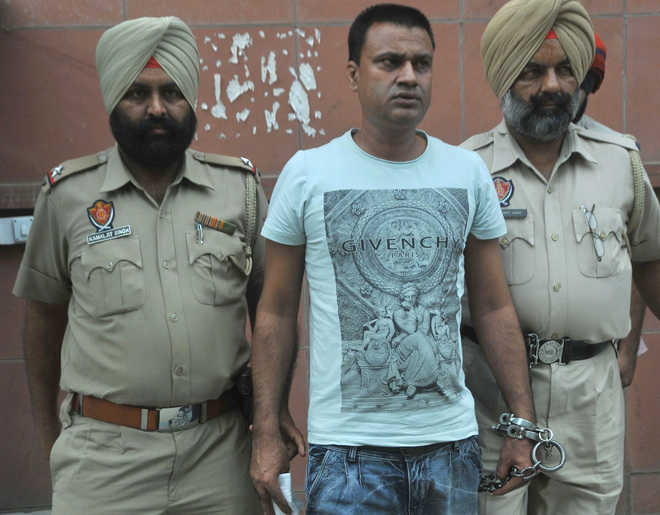
Convict Khushwinder Singh in custody. tribune photo
Fifteen years on, a Punjab and Haryana High Court Division Bench of Justices Rajiv Sharma and Gurvinder Singh Gill today upheld the death sentence for Khushwinder, pronounced by the Mohali CBI special judge.With the CBI probe hitting a dead-end, the case had to be shut in September 2009. But a letter from the Punjab ADGP (Crime) to the CBI in July 2012 led to its reopening. 

The ADGP said Khushwinder, an accused in a similar case of killing of a family where a female member survived, had during investigation confessed to his involvement in pushing to death Kulwant and his family.Speaking for the Bench, Justice Sharma said the motive attributed was that Khushwinder wanted to grab Kulwant’s money from a recently sold property. After developing close ties with Kulwant, who was under debt, Khushwinder persuaded the victim family to accompany him to the crime spot and pushed them into the water. While the bodies of Kulwant and his daughter Ramandeep Kaur were recovered, those of his wife Harjit Kaur and son Arvinder Singh could never be found.

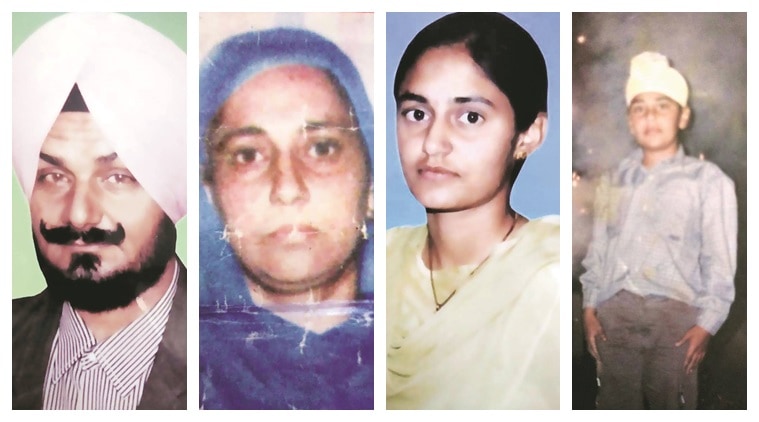
Four members of a family killed (left to right) – Kulwant Singh, Harjeet Kaur, Ramandeep Kaur and Arvinder Singh
“It has been proven on record that the appellant had planned the murder of Kulwant and his family. He pushed them into the Bhakra canal. He has played with the sentiments of gullible family… The case falls within the ambit of rarest of rare cases. The appellant has killed four persons, including two minor children. There is no occasion for us to interfere with the well-reasoned judgment and order of the trial court,” asserted Justice Sharma.

Case files 
  • Khushwinder can still move the Supreme Court, file a mercy petition before the President, and challenge the rejection of that as well
  • In August 2004, Dhananjoy Chatterjee was sent to the gallows for killing and raping a minor in West Bengal 
  • All executions since then have been in terror cases — be it in Parliament attack case (Afzal Guru), Mumbai 26/11 case (Ajmal Kasab) or 1993-Mumbai blasts (Yakub Memon)

To fast-track sex assault probe, states to get forensic kits

TNN | Apr 22, 2019, 03.28 AM IST

NEW DELHI: The women safety division of the ministry of home affairs has set its focus on expediting investigations in a time-bound manner. According to the latest updates available with MHA, Madhya Pradesh is showing the way especially in particularly heinous cases securing the death sentence in 21 rape/POCSO Act cases since Criminal Law (Amendment) Act came into force in 2018. As per the investigation tracking system for sexual offences (ITSSO) launched on February 19, the MHA cites Haryana, Delhi, Madhya Pradesh and Uttar Pradesh as the leading states/UTs in terms of completion of investigations within two months. MHA set up ITSSO, an online mechanism to monitor and track investigation in sexual assault cases in accordance with the 2018 amendment to the law. 

It is an analytical tool based on CCTNS data available right from the police station to national level. Meanwhile, 2,575 officers have been trained by Bureau of Police Research and Development (BPR&D) and National Institute of Criminology and Forensic Sciences in collection, handling and transportation of forensic evidence, including trace elements like a single strand of hair, dead skin cells, blood etc. 

BPR&D has also procured 3,120 Sexual Assault Evidence Collection (SAEC) Kits for distribution to states/ UTs as orientation kit as part of training. The handling of evidence is based on the notified guidelines for collection of forensic evidence in sexual assault cases and standard composition in a sexual assault forensic kit. The latest update on the 'Emergency Response Support System (ERSS)' with a single emergency number (112) shows that it has been operationalised in 20 states and union territories. These include Andaman Islands, Andhra Pradesh, Chhattisgarh, Dadra & Nagar Haveli, Daman & Diu, Madhya Pradesh, Gujarat, Himachal Pradesh, Jammu & Kashmir, Kerala, Lakshadweep, Nagaland, Puducherry, Punjab, Rajasthan, Tamil Nadu, Telangana, Uttarakhand & Uttar Pradesh, and Mumbai city. From the Nirbhaya Fund, Rs 292.89 crore has been utilised so far for this project.

Convicted (death sentence) escape from High Security Hindalga Jail Belagavi (Karnataka)

Apr 25, 2019

In a filmy style, a convicted for sentence to death and four other Jail inmates allegedly gave slip to the security personnel and escaped from the High Security Hindalaga Central Jail here on April 22. According to official sources on Thursday, Muragesh, hailing from Tamil Nadu was undergoing jail term after he was awarded death sentence by a Sessions Court, Chamarajanagara in 2015 on charges of brutal murder of five people, including a 8-year-old girl in Hrale village in Chamarajanagara district. 

Murugesh had been shifted from Chamarajanagara district prison to the Belagavi Central jail in 2017 and allegedly hatched a plot to flee from the Jail, as number of security personnel were reduced following deployment to the Election duties, on April-23. He managed to escape from the jail on April 22 by scaling the prison wall with four other inmates. Police said that man hunt was launched to nab Muragesh and other four who have escaped. UNI MV MSP SKB130