Showing posts with label Prime Minister Rajiv Gandhi. Show all posts

Thursday, May 30, 2019

Rajiv Gandhi killing: SC dismisses plea against convicts' release (Tamil Nadu)

09 MAY 2019 Last Updated at 7:12 PM | SOURCE: IANS

The Supreme Court on Thursday dismissed the plea by families of those killed along with former Prime Minister Rajiv Gandhi by a LTTE suicide bomber at Tamil Nadu's Sriperumbudur on May 21, 1991, opposing the release of the seven remaining convicts in the case.

A bench, headed by Chief Justice Ranjan Gogoi, said: "All aspects were covered in the earlier constitution bench verdict in the case and, therefore, nothing survives in the case. In view of the above, the writ petition stands disposed of." As an outcome of the apex court's decision, Tamil Nadu Governor Banwarilal Purohit will take a decision regarding freeing the seven convicts held guilty in the assassination of the former PM and 16 others. On September 9, 2018, the Tamil Nadu Cabinet passed an order recommending the release of the convicts but the issue has been pending before the Governor, who is yet to take any decision, as the petition of the victims' families was pending in the top court.

When in 2014, the then Chief Minister J Jayalalithaa decided to free the convicts, who have already been in jail for 28 years after the apex court commuted their death sentences to life imprisonment, K. Ramasugandam, John Joseph, R. Mala, M. Samuvel Diraviyam, America V. Narayanan and S. Abbas filed a petition against it in the apex court. Senior advocates Gopal Sankaranarayanan and Prabu Ramasubramanium, representing A.G. Perarivalan, who is one of the seven convicts, brought the CJI's attention to the victims' petition pending in the top court since 2014. They also argued that none of the convicts were ever made parties in the case, despite that their lives were directly linked, and as a consequence, the petition has become infructuous.

Agreeing with the argument, the court said: "Having considered the matter, we are of the view that no live issue remains for adjudication in view of the Constitution Bench judgement of this court." A five-judge Constitution bench, headed by then Chief Justice H.L. Dattu, had in 2015 upheld Centre's right to decide, on the remission of sentence of life convicts, specifically where the case was investigated by the Centre. It then allowed the three-judge bench to give the final word on the case. Sankaranarayanan contended the three-judge bench had already closed the case, and as a consequence, there is simply nothing left in the top court and the court agreed.

Following these verdicts in 2015, the Tamil Nadu government had written to the Centre in March 2016 proposing remission of sentence of these convicts as it expected the Centre would be in harmony on this issue. But, in April 2018, the Centre refused to budge from its previous stand opposing the release, saying the crime was unparalleled in the history of the country. The apex court took an opposite stand to the Centre in September 2018, and asked the Tamil Nadu Governor to decide the fate of the convicts.

Tuesday, February 19, 2019

Rajiv Gandhi assassination convicts Nalini, Murugan launch hunger strike (Tamil Nadu)

Feb 11, 2019 21:10 IST
M Manikandan 
Hindustan Times, Chennai

Nalini Sriharan and her husband Murugan have been in prison for 28 years and their death sentences were commuted to life in prison. 

Five months after the Tamil Nadu cabinet recommended their release from jail, Nalini Sriharan (55) and her husband Murugan (52), two convicts serving life sentences in the Rajiv Gandhi assassination case, have gone on indefinite hunger strike in Vellore Central prison demanding their early release.

They have also appealed to the Tamil Nadu Governor Banwarilal Purohit to release the other five convicts in the case - Perarivalan, Santhan, Robert Payas, Jayakumar and Ravichandran. According to P Pugazhendhi, Nalini’s lawyer, since the TN Governor Banwarilal Purohit has not responded to the Cabinet’s resolution passed last September recommending the release of seven convicts, the husband and wife duo have started an indefinite hunger strike. “While Nalini started her protest inside the special prison for women in Vellore on Saturday, her husband Murugan launched his hunger strike protest on February 2. Even as the state government has urged the TN Governor for the release of seven convicts, the Governor has not taken any decision. Even though all the seven convicts have spent most of their lives in prison, it is not fathomable why the Governor is delaying the signing of papers enabling their release in spite of the TN cabinet resolution recommending the same,” Pugazhendhi said.

The lawyer said Murugan had been drinking only water since February 2. On February 8 when he met him, Murugan had stopped taking water. The prison staff could not be contacted for comments on Nalini and Murugan’s health but Pugazhendhi said they had requested the duo to end their fast. The Tamil Nadu cabinet had passed a resolution in September last year urging the Governor to release the seven convicts under Article 161 of the Constitution. Nalini also wrote a letter to the Governor on Saturday. “I want to go away from the earth by observing fast from Saturday morning, till I accomplish eternal freedom. Justice was denied to us for the past 28 years. We all are just innocent and circumstances made investigation officers to bring us under this case,” Nalini said in her letter.

Pugazhendhi also said that they would file a petition in the Madras high court seeking a direction to the Governor to take action on the Tamil Nadu Cabinet’s resolution. When Perarivalan approached the Supreme Court last August for release, the Union Government had declined to release the seven accused saying that it would set a wrong example. Former Prime Minister Rajiv Gandhi was killed in Sriperumbudur near Chennai, when he was attending an election rally on May 21, 1991 by a suicide bomber named Dhanu of the Sri Lankan rebel group Liberation Tigers of Tamil Eelam (LTTE).

A Special Investigation Team (SIT) had taken 23 people into custody for investigation and a trial court had awarded death sentence to all. In 1999, the Supreme Court released 19 accused and convicted three people for a life. But it had upheld the death sentence for Nalini, Murugan, Santhan and Perarivalan. In April 2000, the then Tamil Nadu Governor Fathima Beevi commuted Nalini’s death sentence into life imprisonment. Eight years after that, Rajiv Gandhi’s daughter Priyanka Gandhi Vadra met Nalini in Vellore prison. Priyanka at that time said that she had forgiven Nalini. In 2014, the Supreme Court commuted the death sentence of Murugan, Santhan and Perarivalan into life sentence citing the delay in examining their mercy petitions.

Source: https://www.hindustantimes.com/india-news/rajiv-gandhi-assassination-convicts-nalini-murugan-launch-hunger-strike/story-oaIxuG7PltdzkZYk3Yn1eJ.html (accessed on 19 February 2019)

Monday, December 24, 2018

Rajiv Gandhi assassination case: CBI seeks dismissal of Perarivalan’s plea (Tamil Nadu)

By PTI |Published: March 12, 2018 1:33:27 pm

On February 18, 2014, the top court had commuted the death sentence of Perarivalan to life imprisonment, along with that of two other prisoners - Santhan and Murugan - on grounds of a delay of 11 years in deciding their mercy pleas by the Centre. 

The CBI has told the Supreme Court that A G Perarivalan’s plea seeking a recall of its May 1999 judgment upholding his conviction in the Rajiv Gandhi assassination case should be dismissed as it was devoid of any merits. In an affidavit filed in the apex court, the CBI’s Multi-Disciplinary Monitoring Agency (MDMA), probing the larger conspiracy aspect behind Gandhi’s assassination, has said that the role of convict A G Perarivalan in the conspiracy resulting in the killings of the former prime minister and others have already been upheld by the top court. The agency said that the application seeking a recall of May 11, 1999, apex court judgment was not maintainable since it seeks to reopen the whole matter on merits which cannot be permissible. The MDMA also said that Perarivalan’s petition seeking review of the apex court’s order upholding his conviction in the case has already been dismissed.

Perarivalan
“It’s, therefore, most respectfully prayed that this court may be pleased to dismiss the application for recall of judgment dated May 11, 1999, in the interest of justice and impose heavy cost 0n the applicant (Perarivalan) herein,” the agency said in its affidavit. The affidavit was filed in pursuance of the apex court’s January 24 direction asking the CBI to respond to Perarivalan’s plea seeking a recall of the May 1999 order upholding his conviction. The court had termed as “serious” and “debatable” the questions raised by Perarivalan. He has sought a recall of the apex court’s order, saying he was not aware of the conspiracy. Former Prime Minister Rajiv Gandhi was assassinated on the night of May 21, 1991, at Sriperumbudur in Tamil Nadu by a woman suicide bomber, identified as Dhanu, at a poll rally. Fourteen others, including Dhanu herself, were also killed.

Gandhi’s assassination was perhaps the first case of suicide bombing which had claimed the life of a high-profile leader. In its May 1999 order, the top court had upheld the death sentence of four convicts — Perarivalan, Murugan, Santham, and Nalini — in the assassination case. In April 2000, the Tamil Nadu governor commuted the death sentence of Nalini on the basis of the state government’s recommendation and an appeal by former Congress president and Rajiv Gandhi’s widow Sonia Gandhi.

On February 18, 2014, the top court had commuted the death sentence of Perarivalan to life imprisonment, along with that of two other prisoners – Santhan and Murugan – on grounds of a delay of 11 years in deciding their mercy pleas by the Centre. In his application, 45-year-old Perarivalan has said that he was held guilty of supplying two nine-volt batteries which were allegedly used in the improvised explosive device (IED) that killed Gandhi. The reasons due to which his conviction was sustained by the apex court would “vanish completely” in the wake of the affidavit by V Thiagarajan, a former CBI officer, it said. Thiagarajan, then a superintendent of police of CBI, had recorded Perarivalan’s confessional statement under the Terrorist and Disruptive Activities (Prevention) Act. The application claimed that in his affidavit the former CBI officer had stated that Perarivalan had expressly stated in his confessional statement that at the time of purchase of the batteries, he had absolutely no idea for what purpose these were going to be used.

While hearing Perarivalan’s plea earlier, the top court had observed that the probe by CBI’s Multi-Disciplinary Monitoring Agency (MDMA) in the larger conspiracy aspect behind Gandhi’s assassination did not appear to have achieved “much headway” and could be “endless”. The MDMA, set up in 1998 on the recommendations of Justice M C Jain Commission of Inquiry which had probed the conspiracy aspect of Gandhi’s assassination, is headed by a CBI official and comprises officers from IB, RAW and Revenue Intelligence and other agencies.

Source: https://indianexpress.com/article/india/rajiv-gandhi-assassination-case-cbi-seeks-dismissal-of-perarivalans-plea-5094953/ (Accessed 24 December 2018)

Sunday, December 23, 2018

Rajiv Gandhi assassination convict Perarivalan shifted to Puzhal prison for treatment (Tamil Nadu)

Akshaya Nath
December 14, 2017 

AG Perarivalan, a life convict in Rajiv Gandhi assassination case, has been shifted to Puzhal prison in Chennai due to severe health issues. He was shifted from the Vellore Central Prison to facilitate treatment at Rajiv Gandhi government general hospital. Perarivalan was referred to the Government General hospital by the Vellore Medical College, where he was undergoing a treatment.

A.G. Perarivalan
Perarivalan is said to be suffering from hypertension, urological and orthopaedic issues. He, along with his family, had been pleading for medical attention since a long time. In 2015, Perarivalan underwent a treatment at Government general hospital. After the treatment, he will be transferred back to the Vellore prison. 

Perarivalan was taken into custody in 1991, and was given death sentence in May 1999. But, later in June 2014, Supreme Court converted his death penalty to life time imprisonment. Perarivalan's mother Arputhammal has been pleading for his release stating that Perarivalan is innocent and never knew of a plan to assassinate the then Prime Minister Rajiv Gandhi.

Source: https://www.indiatoday.in/india/story/rajiv-gandhi-assasination-ag-perarivalan-puzhal-prison-chennai-1107145-2017-12-14 (Accessed 23 December 2018)

Judge who handed death to Rajiv Gandhi killers writes to Sonia: Show magnanimity (Tamil Nadu)

Written by Arun Janardhanan |Chennai |Updated: November 16, 2017 7:30:55 am 

Speaking to The Indian Express, Justice Thomas said there were “serious flaws” in the CBI’s investigation in the Rajiv Gandhi assassination case. 

Justice K.T.Thomas
The judge who headed the three-member Supreme Court bench that confirmed the punishment to the convicts in the Rajiv Gandhi assassination case has written a letter to the former prime minister’s wife and Congress president Sonia Gandhi, requesting her to “show magnanimity” and convey her willingness for the remission of sentences of those who have been in jail since 1991. In the letter dated October 18, Justice (retd) K T Thomas pointed out that a decision to grant remission by the Tamil Nadu government in 2014 was opposed by the Centre — the matter is pending before the Supreme Court. “Perhaps the Union government would agree if you and Rahulji (if possible Priyankaji also) would write to the President of India conveying your willingness to grant remission to these persons who have already spent the longest period of their life in prison. It appears to me as a matter of human consideration which you alone can help. As the judge who passed the judgment against these persons I now feel that I should address this letter to you so that you can show magnanimity in the situation,” the letter stated.

Speaking to The Indian Express on Wednesday, Justice Thomas confirmed the contents of the letter and said that he was seeking “compassion” for the convicts. He said there were “serious flaws” in the CBI’s investigation in case, particularly related to the seizure of Rs 40 lakh in cash from the convicts, which led him to believe that the probe exposed “an unpardonable flaw” in the “Indian criminal justice system”. In the letter, Justice Thomas referred to the central government’s decision in 1964 to set free Gopal Godse, brother of main accused Nathuram Godse, who was charged with conspiracy in the Mahatma Gandhi assassination case after 14 years of imprisonment. Justice Thomas ended his letter with these lines: “I also feel that God Almighty will only be pleased by showing the magnanimity to those prisoners. I may be excused if I have done anything wrong in requesting you as above.”

On May 11, 1999, the bench headed by Justice Thomas, and including justices D P Wadhwa and Syed Shah Mohammed Quadri, confirmed the conviction of seven persons in the case — four were sentenced to death, including Murugan alias Sriharan and his wife S Nalini, Santhan and A G Perarivalan, and three to imprisonment for life. In the case of Nalini, the only accused at the site of the blast that killed Rajiv Gandhi in Sriperumbudur on May 21, 1991, Justice Thomas gave a dissenting, but minority, verdict awarding imprisonment for life. In 2000, Nalini’s death sentence was commuted to life term.

In 2008, Priyanka Gandhi met Nalini at the Vellore jail and later described the visit as her “way of coming to peace with the violence and loss that I have experienced”. In 2014, the Supreme Court commuted the death sentence of the three other convicts to imprisonment for life. Speaking to The Indian Express, Justice Thomas said he has often wondered whether the bench handed down a “severe punishment” because the convicts were linked to a high-profile assassination. “If it was not a high-profile case, what would have been the outcome? I don’t have answers,” he said. Describing his decision to seek Sonia Gandhi’s intervention in favour of the convicts as “tough”, Justice Thomas said, “They are considered as the killers of Rajiv Gandhi. But do not mistake me, I am requesting her to have compassion at this stage,” he said. ”We had such values under Panditji (Jawaharlal Nehru), too, in the release of Gopal Godse after 14 years of life imprisonment inspite of conspiracy charges he faced in the assassination of Mahatma Gandhi,” Justice Thomas said. Gopal Godse was released in October 1964, five months after Nehru’s death, before being re-arrested for another year.

A.G. Perarivalan, one of the seven convicted in Rajiv Gandhi killing. (File Photo)
Referring to the case of Perarivalan, Justice Thomas said it brought to fore another aspect of the assassination case that generated intense debate over using the confession of one accused against another. ”Under the conventional Evidence Act, a confession can be used only as a corroborative piece of evidence. But the two other judges on my bench did not agree, they insisted that we should use it as substantive evidence. To prevent the laying of such a wrong law, I called them to my home where we had several rounds of debates in which I tried to convince them. But the majority view in the judgment considered the confession statement as substantive evidence as it was under TADA [Terrorist and Disruptive Activities (Prevention) Act]. Later, many senior jurists called me to say that the majority order laid a wrong law in the case,” he said.

In 2013, Justice Thomas had raised the question of double jeopardy in the case and said that hanging three convicts after 24 years — at the time — would be unconstitutional. Referring to the CBI probe in the case, Justice Thomas said he was “agitated” during the trial over “serious flaws” by the Special Investigation Team, especially when the agency claimed ignorance about the source of Rs 40 lakh seized from the accused. “The main accused were all from Sri Lanka. I told the then solicitor general Altaf Ahmed that I can understand the seizure of a few Sri Lankan currency but Rs 40 lakh was such a huge amount in that period. That means there were financially powerful forces behind those who were arrested. I asked him whether he investigated the origin of that cash. After a brief chat with the investigation chief D R Karthikeyan, he sought time to reply. The next day, Ahmed told the court that investigators couldn’t find the source of the cash,” said Justice Thomas.

“I was upset over these serious flaws and shared my concerns with the two others on the bench. They suggested that we shouldn’t criticise the CBI in the final order, considering their efforts. Then I suggested a condition: no criticism or kudos for CBI in the final order. They agreed. After drafting the final orders, we exchanged the drafts for reading. But on the day of the judgment, I was shocked to hear Justice D P Wadhwa’s judgment praising CBI officer Karthikeyan wholeheartedly. That made headlines… sending out a message that the Supreme Court was fully happy with the probe,” he said.

“Since I was the senior judge, he read out his draft only after mine. If I knew about changes he brought in his order, I would have corrected mine, too, to stand by my observations,” said Justice Thomas. When contacted in Kolkata by The Indian Express over phone, Justice (retd) Wadhwa declined to comment on Justice Thomas’s version. After his bench’s verdict, which also released 19 other convicts in the case, Justice Thomas said that he read an interview of one of those freed in The Week magazine.

Source: https://indianexpress.com/article/india/judge-who-handed-death-to-rajiv-gandhi-killers-writes-to-sonia-show-magnanimity-4939399/ (Accessed 23 December 2018)

‘I am going home’ (Tamil Nadu)

Written by Arun Janardhanan |Updated: September 24, 2017 11:12:10 am
What parole, after 27 years of wait, means for Rajiv Gandhi assassination convict A G Perarivalan and his family
Perarivalan's mother at their home. Policemen sat in the verandah through the parole, keeping a watch on visitors (Arun Janardhanan). 
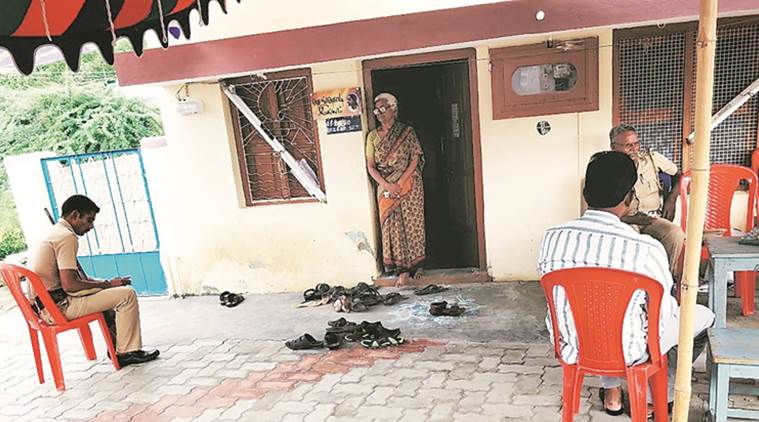
It was around 7.45 pm on August 24 and he was preparing to go to sleep when the key turned and a jail official entered his cell. “Okay, come out,” the official told A G Perarivalan. “You have got parole.” It took several minutes for the balding, middle-aged convict to register the news, the official recalls. Convicted in the Rajiv Gandhi assassination case, Perarivalan alias Arivu had been arrested in June 1991 at the age of 19. In the 26 years hence, he hadn’t been let out on a single day’s parole or bail. “All he picked up on his way out was a lungi. We suggested he take some extra clothes, apart from the shirt and trousers he was wearing,” says the official. “He replied, ‘Why should I? I am going home’.” When Perarivalan stepped out of Vellore Central Prison around 9 on a humid night, there was no one to receive him. His mother, Arputham Ammal, 66, who has been almost single-handedly fighting for his early release from jail, had said she would believe he was finally coming home when he returned. The announcement of the parole, for Perarivalan to see his ailing father, had come out of the blue.

It is 80 km to their home in Jolarpet, and it took Perarivalan, accompanied by a dozen policemen in two vehicles, 90 minutes to reach. Ammal says she asked him later what he saw along the way. “He did not see anything except a four-lane highway,” she says, her eyes welling up. “When the convoy crossed Ambur and Vaniyambadi, he asked policemen about those towns. But they said they wouldn’t be entering any, just stick to the highway.” At Jolarpet, a full house awaited him, including his parents, his married sisters A G Anbumani (who teaches at Annamalai University) and A G Arulselvi (an engineer with the Rural Development Department), their families, and other relatives and friends. More would keep dropping by all month long. Each registered their names and addresses with the policemen who sat outside the two-room house, in the verandah, keeping a watch.

As per the conditions of his parole, Perarivalan couldn’t give interviews or be photographed, or leave his home. The visitors also had to leave their phones outside. “No selfies,” Ammal says. ‘Selfie’ was a word Perarivalan heard for the first time in jail. It was also in prison that he learnt that Anbumani’s son, whom he saw as a 15-day-old infant in 1992, had become a software engineer. Ammal says the 25-year-old took leave to visit his uncle. “Perarivalan couldn’t stop smiling at the clothes the boy got him.”

The 45-year-old struggled to identify other visitors. Some tried to jog his memory telling him their name, others recounted anecdotes from a shared school trip or an NCC camp. Perarivalan was sentenced to death in May 1999, on the charge of purchasing an 8-volt battery used by the assassins to trigger the belt bomb that killed Rajiv Gandhi. In 2014, his sentence and that of two others, Murugan and Santhan (both Sri Lankans), was commuted to life. Soon after, the Tamil Nadu government ordered the release of all seven convicts in the case, but the Centre went to the Supreme Court to stop this. The matter stands there.
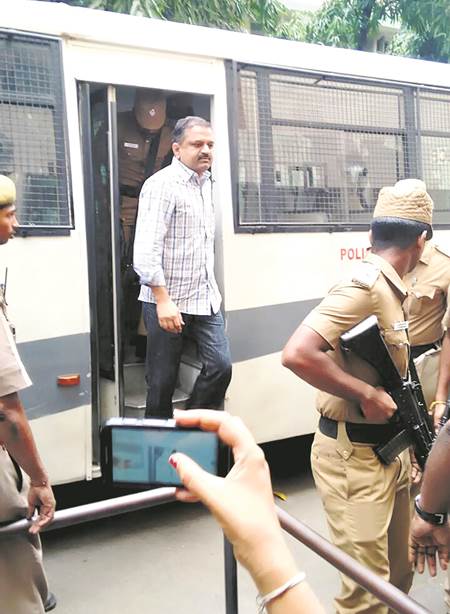
Perarivalan in 2015, when he was taken to Chennai for treatment. (File)
Perarivalan continues to plead that he didn’t know about the main conspiracy. Says Ammal, “All these visitors… nobody here believes he is a murderer. Even after all these years in prison, he tells me he is innocent. That is why I am still fighting for him.” Their house hasn’t changed much in these nearly three decades — the family lives on his father’s pension — but the world outside has sped on, even in the village. Perarivalan spent most of his day on the house’s terrace taking it all in. Their home is located on the foothills of the scenic Yelagiri hills, and Perarivalan remarked how what used to be a vacant plot nearby had a concrete house on it now, and that all around were multi-storey structures. “He lamented that his favourite creche teacher, Babyamma, was no more. He couldn’t even spot where her house used to be down the street,” Ammal says.

His biggest source of wonder were the two cellphone towers opposite their house, sheltering dozens of monkeys. In prison, Perarivalan doesn’t have access to TV, except for rare film screenings, but can receive newspapers, occasional visitors, and is allowed one phone call of nine minutes every six days. Perarivalan told friends about a visit to Chennai in 2015, where he was taken for treatment for back pain, urinary problems and hypertension. He then realised a lot had changed — he could identify only two buildings, Ripon Building and the Chennai Central station. He was struck by the roads, the people busy with cellphones, and especially “the children talking like adults”.

But the biggest blow was seeing the change in his father Njanasekharan, who once taught Tamil at the Jolarpet government school, wrote Tamil poems under the pen name Kuyildasan, and was known as a scary drill master. The 75-year-old looks like a frail man in his 90s now, and suffers from hypertension, bronchial asthma, acute diabetes and neurological issues. Njanasekharan says Perarivalan carried him up to the terrace during his days home. There, as the son and father together lay in the sun, on the advice of doctors, Njanasekharan says his heart would break. “Arivu was the school topper, the best NCC cadet, he won many awards. See his fate now,” he says.

Ammal constantly fretted about how their small house would accommodate all the visitors. But she fretted about something even more. “I am too old and was too nervous to prepare a feast for my Arivu when he came home at such short notice. So I made only dosa,” she says. Later, everyone coming along got him delicacies he liked. A group of friends sent over boxes full of fish products and crabs from Chennai. “Fish curry is his favourite, and he hadn’t tasted it after 1991 as Tamil Nadu prisons don’t serve fish,” says a stoic Ammal. Perarivalan told one of the visitors, James Kurian, a senior professor of philosophy at the Madras Christian College, that it would be forgotten smells, like that of fish, that he would carry back to prison. Kurian remembers Perarivalan sniffing appreciatively one day as firewood smoke wafted to the terrace where they sat, from a kitchen nearby.

“He said his senses had started diminishing from years of seeing nothing but walls. He talked about obsessively counting the bricks, estimating the size of the door, the bolts. He remembered exactly the 6×9 feet cell he spent 11 years of his initial prison term in, in solitary confinement.” The worst years though have been the last three years, Kurian adds, after Perarivalan’s death sentence was commuted to life. With hopes of a release rising, he has been fighting anxiety. Perarivalan jokes that this is why he has lost his hair. Murugan and Santhan, the other two convicts whose death sentence was commuted, are reportedly suffering from depression. Recently, Murugan sought mercy killing.

Perarivalan fears some changes in him may be irreparable. Kurian says having lived alone all these years, he gets anxious amidst crowds now. Children and their frankness trouble him even more, and he couldn’t believe how much his sister Arulselvi’s daughters wanted to see him. Among the visitors was another child, the nine-year-old son of a schoolmate. Perarivalan was very embarrassed as he couldn’t place the friend. To lessen the embarrassment, he asked the boy his name. When the boy said ‘Perarivalan’, he was stunned. Ammal, crying every such time, finally sought relief in musician Ilayaraja. When he was a young boy, Perarivalan would sing Ilayaraja songs with his mother. Some friends who have been helping Ammal in Perarivalan’s case, including aspiring filmmakers and cinematographers, brought along a keyboard, and the mother and son sang together again.

The first song Perarivalan sang was Ponna Pola Aatha, about “a mother pure as gold” giving birth, and getting “only sorrow in return”. Ammal now lives on fresh hope. Plucking jasmine flowers to make a garland for Arulselvi’s daughter, she says, “I met CM Edappadi K Palaniswami. He asked me why I had wasted a day to come see him when my son was home. I said I just wanted to thank him, and prayed to him to let Arivu go. He said hopefully soon, if the Centre permits.” Kurian says this time the promise must be kept. He repeats Perarivalan’s words — “Even if the entire world is brought into a cell, it is still a prison.”

Arputhammal, mother of A.G. Perarivalan. Photo: S. Vijay Kumar
Ammal recalls others. “A friend from Sathyamangalam got for him three country chickens to eat. We cooked one. Arivu joked ‘one among them was sentenced to death, and two others were commuted to life and later pardoned’. Now they roam around the house freely.”

Source: https://indianexpress.com/article/india/a-g-perarivalan-rajiv-gandhi-assassination-convict-4858177/ (Accessed 23 December 2018)

Rajiv Gandhi case: Hearing deferred in SC (Tamil Nadu)

New Delhi, Sep 19 (PTI) The hearing in the case relating to a probe on the conspiracy aspect behind the making of the bomb that had killed former Prime Minister Rajiv Gandhi 26 years ago, was deferred in the Supreme Court today. 

The matter, which was listed before a bench comprising Justices Ranjan Gogoi and Navin Sinha, was called for hearing in the pre-lunch session but the counsel appearing for the petitioner requested that it should be taken up later in the day. However, the matter could not be taken up for hearing in the post-lunch session as the bench was busy hearing other regular matters. The Centre had earlier filed a report in a sealed cover in the court on the investigation being carried out on the conspiracy aspect behind the making of the belt-bomb.

Perarivalan 
Rajiv Gandhi was assassinated on the night of May 21, 1991 at Sriperumbudur in Tamil Nadu by a woman suicide bomber, identified as Dhanu, at an election rally. Fourteen others, including Dhanu herself, were also killed. This was perhaps the first case of suicide bombing claiming the life of a high-profile global leader. The apex court had on August 17 asked the Centre and the CBI to apprise it of the probe being carried out on the conspiracy aspect behind the making of the bomb after petitioner A G Perarivalan had claimed that this aspect was not being probed properly.

Perarivalan's counsel had earlier told the court that several aspects, including the conspiracy angle behind making of the bomb, have not been probed properly. The counsel had told the court that Perarivalan was held guilty of supplying the batteries for the belt-bomb worn by Dhanu that had killed Rajiv Gandhi. The apex court had earlier commuted to life term the death sentence awarded to Perarivalan in the case. It was hearing a plea by Perarivalan, who has alleged that neither the CBIs special investigation team, nor the Multi Disciplinary Monitoring Agency (MDMA) headed by it, had proceeded with the probe in a proper perspective to bring the accused to book, as several top people were involved in it.

The apex court had on February 18, 2014 commuted the death sentence of Perarivalan to life imprisonment, along with two other condemned prisoners -- Santhan and Murugan -- on grounds of a delay of 11 years in deciding their mercy pleas by the Centre.

Source: https://www.indiatoday.in/pti-feed/story/rajiv-gandhi-case-hearing-deferred-in-sc-1048107-2017-09-19 (Accessed 23 December 2018)

Thursday, December 20, 2018

Rajiv Gandhi assassination convict Perarivalan attacked with iron rod in jail (Tamil Nadu)

September 13, 2016UPDATED: September 14, 2016 00:09 IST 

Police sources said the Rajiv case convict received blows from the rod on his forehead, scalp and also his arms when he tried to fend off the attack. 

AG Peralivalan, one of the seven convicts in the Rajiv Gandhi assassination case, was today assaulted with an iron rod inside the high security central prison here by another inmate.

ATTACK AND MOTIVE
Perarivalan, who has been lodged in the high security block, was attacked by another inmate Rajesh Khanna, a life convict in a murder case. "Perarivalan was attacked...with an iron rod and it was used by another convict who is also in the high security block, to assault the Rajiv case convict," a top jail official told PTI, adding he was now doing well. Police sources said the Rajiv case convict received blows from the rod on his forehead, scalp and also his arms when he tried to fend off the attack. He was taken to hospital where his wounds were sutured, dressed and treated. They said an inquiry was being held by senior prison officials. On the reason for the attack, they indicated it was related to shifting Khanna to another block. They declined to go further into it, since an inquiry was being held.

PARTIES DEMANDS PROTECTION
Learning about the incident, Perarivalan's mother Arputhammal visited him. Later speaking to reporters here, she wondered how her 'soft-spoken' son could have become the target of an attack. Perarivalan, also known as 'Arivu' has been in prison for over 25 years after he was convicted in the case. Political parties, including the Pattali Makkal Katchi (PMK), have demanded that the culprits behind the incident be punished. PMK Chief Ramadoss said those behind the attack should be punished. He urged the Tamil Nadu Government to free all seven convicts on remission and in case of the legal process delaying their release, the state should give them leave. MDMK Chief Vaiko condemned the attack, saying the incident raised doubts if it was an attempt to murder Perarivalan. He demanded that the state provide him adequate security and find out the reason behind the attack. He also urged the government to release Perarivalan on parole.

RECAP
Rajiv Gandhi was killed by a suicide bomber at Sriperumbudur near Chennai on May 21, 1991. Seven persons - Murugan, Santhan, Perarivalan, Nalini, Robert Payas, Jayakumar and Ravichandran, were convicted in the case. Nalini's death sentence was commuted to life in 2000 following a cabinet recommendation and appeal by Rajiv's wife, Sonia Gandhi. The Supreme Court had commuted the death sentence of Murugan, Santhan and Perarivalan in February 2014 following delay in deciding on their mercy plea. The Tamil Nadu Government had in March this year decided to remit the sentences of all the seven convicts. However, the matter soon went to the Apex Court and is pending there, with the Centre questioning the state's powers to grant remission to them on specific grounds.

Source: https://www.indiatoday.in/india/story/rajiv-gandhi-assassination-tamil-nadu-pmk-340913-2016-09-13 (Accessed 20 December 2018) 

Wednesday, December 19, 2018

Executive's power to remit sentence can't be taken away: Supreme Court judges

Updated: Dec 3, 2015, 12:13 AM IST

Courts cannot take away the statutory powers of the Centre and the states to grant remission to convicts, two judges of the Supreme Court on Wednesday said in a dissenting verdict. Justices UU Lalit and A M Sapre, who concurred with other three judges led by Chief Justice HL Dattu on six questions arising out of Tamil Nadu government's decision to free killers of Rajiv Gandhi, differed on the issue and said the courts cannot quantify the jail term leading to a situation where Executive is stopped from exercising their power of remission provided under CrPC.

"In our view, it would not be open to the court to make any special category of sentence in substitution of death penalty and put that category beyond application of remission, nor would it be permissible to stipulate any mandatory period of actual imprisonment inconsistent with the one prescribed under Section 433A of CrPC," Justice Lalit, who wrote 80-page long separate judgement, said. The verdict also said that the life imprisonment "means imprisonment for the rest of life or the remainder of life of the convict".

However, such a convict can "always apply for obtaining remission" either under the provisions of the Constitution or under CrPC and "the authority would be obliged to consider the same reasonably". The three other judges namely CJI Dattu and justices FMI Kalifulla and P C Ghosh upheld the principles enunciated in the Swamy Shraddananda judgement which had said that "a special category of sentence may be made for very few cases where the death penalty might be substituted by the punishment of imprisonment for life or imprisonment for a term in excess of 14 years" and they can put beyond the power of remission of the executives.

Referring to the Shraddananda judgment, the majority view said that courts can ignore remission right in heinous crimes like mass murder and terrorism by awarding sentences ranging from 20 to 40 years unless it is not rarest of rare offences emitting death sentence. "We hold that the ratio laid down in Swamy Shraddananda that a special category of sentence, instead of death can be substituted by the punishment of imprisonment for life or for a term exceeding 14 years and put that category beyond application of remission is well-founded and we answer the said question in the affirmative," the majority judgement said.

Source:  https://www.dnaindia.com/india/report-executive-s-power-to-remit-sentence-can-t-be-taken-away-supreme-court-judges-2151388 (Accessed on 19 December 2018)

TN can’t release Rajiv killers without consulting Centre, says Supreme Court

Written by Utkarsh Anand |New Delhi |Updated: December 3, 2015 12:15:13 am

The judgment is a setback to J Jayalalithaa’s government in Tamil Nadu which had in February 2014 decided to release all the seven convicts in the case. 

Blocking the release of seven convicts in the Rajiv Gandhi assassination case, the Supreme Court Wednesday said state governments cannot remit jail terms of convicts in cases of national importance without the Centre’s approval. The court blocked the J Jayalaithaa-led Tamil Nadu government’s move to free all seven convicts, and said no remission can be granted by “putting the interest of the nation in peril”. Regretting that “lawlessness is the order of the day”, the Constitution Bench held that a state government cannot be allowed to exercise its power of remission and free convicts in cases which have been investigated by central agencies such as CBI and NIA and where offences entail death penalty or conviction is for an offence relating to Executive Power of the Union. 

The bench, led by Chief Justice H L Dattu, held that cases such as the killing of a former prime minister would mean assassinating “national figures of very high status by resorting to diabolic criminal conduct” and that “such a situation should necessarily be taken as the one coming within the category of internal or external aggression”. The judgment, by a 3:2 majority, noted that granting the Centre overriding authority in cases of national importance “cannot held to be interfering with the independent existence of the state concerned”. While Justice F M I Kalifulla, the author of the verdict, and Justice P C Ghose wrote the majority judgment with the CJI, Justice Uday U Lalit and Justice Abhay M Sapre concurred with them on all issues except one legal point.

Murugan-Santhan-and-Perarivalan
The two judges differed on whether there can be a “special” category of punishment beyond 14 years in jail and if the power of the state government for remission can be curtailed. Underscoring that life imprisonment means jail term till the end of one’s natural life, the majority verdict held that there is no bar on a high court and the top court to sentence a convict to 20 or 30 years in jail without benefit of remission. Referring to the Rajiv Gandhi case, the court said: “We find no scope to apply the concept of ray of hope to come to the rescue of such hardened, heartless offenders, which if considered in their favour will only result in misplaced sympathy and again will not be in the interest of society. Therefore, we reject the said argument outright.” It also criticised the Tamil Nadu government for exercising its power of remission “suo motu”.

The bench ruled that no state can carry out this exercise suo motu and there has to be an application by the convict first. On February 18, 2014, the apex court had commuted death sentence of three convicts in the case — Murugan, Santhan and Perarivalan — due to inordinate delay by the executive in deciding their mercy plea. The next day, the Tamil Nadu government suo motu ordered the release of all seven life convicts. The Centre then rushed to the court on February 20, 2014 and got their release stayed. The bench then framed seven questions and referred it to a Constitution Bench. After Wednesday’s verdict, the case has been sent back to the three-judge bench.

Source: https://indianexpress.com/article/india/india-news-india/convicts-in-rajiv-gandhi-assassination-case-will-remain-behind-bars-sc-rules/ (Accessed on 19 December 2018)