Showing posts with label Justice Rajiv Sharma. Show all posts

Thursday, May 30, 2019

Death (sentence) upheld for man who pushed 4 into Bhakra (Punjab)

Saurabh Malik
Tribune News Service
Chandigarh, April 25, 2019

HC upholds death sentence in 15-yr-old case

Worshipping with their eyes closed on the banks of Bhakra canal on June 3, 2004, Kulwant Singh, his wife and two minor children were pushed into the water by a relative, Khushwinder Singh of Fatehgarh Sahib, who had taken them there on the pretext of seeking blessings from a “baba”.

Man gets death penalty for murdering four of family
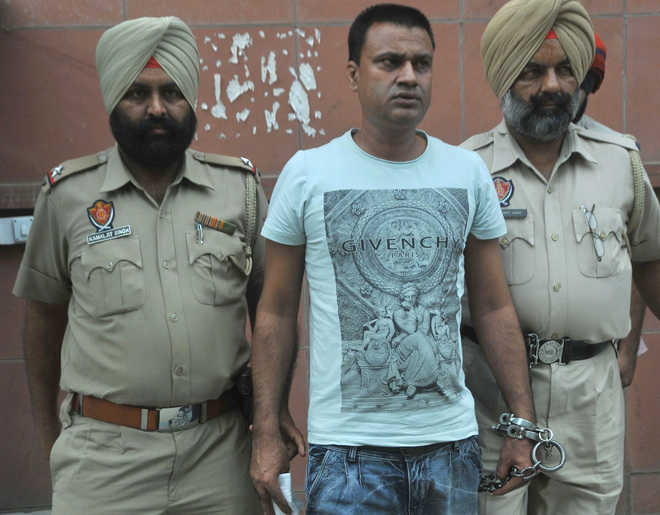
Convict Khushwinder Singh in custody. tribune photo
Fifteen years on, a Punjab and Haryana High Court Division Bench of Justices Rajiv Sharma and Gurvinder Singh Gill today upheld the death sentence for Khushwinder, pronounced by the Mohali CBI special judge.With the CBI probe hitting a dead-end, the case had to be shut in September 2009. But a letter from the Punjab ADGP (Crime) to the CBI in July 2012 led to its reopening. 

The ADGP said Khushwinder, an accused in a similar case of killing of a family where a female member survived, had during investigation confessed to his involvement in pushing to death Kulwant and his family.Speaking for the Bench, Justice Sharma said the motive attributed was that Khushwinder wanted to grab Kulwant’s money from a recently sold property. After developing close ties with Kulwant, who was under debt, Khushwinder persuaded the victim family to accompany him to the crime spot and pushed them into the water. While the bodies of Kulwant and his daughter Ramandeep Kaur were recovered, those of his wife Harjit Kaur and son Arvinder Singh could never be found.

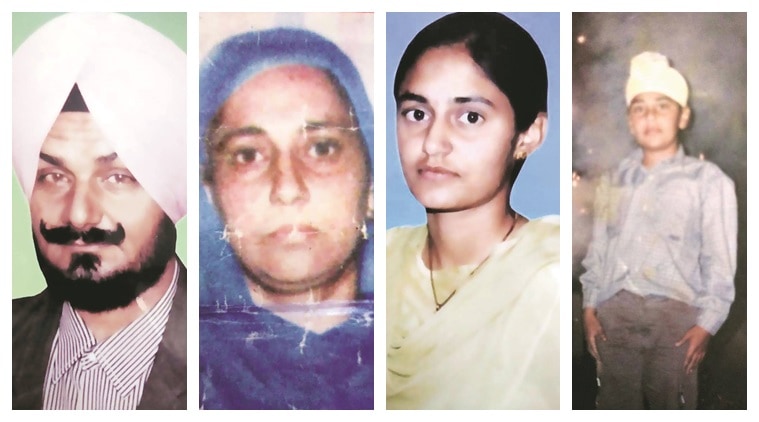
Four members of a family killed (left to right) – Kulwant Singh, Harjeet Kaur, Ramandeep Kaur and Arvinder Singh
“It has been proven on record that the appellant had planned the murder of Kulwant and his family. He pushed them into the Bhakra canal. He has played with the sentiments of gullible family… The case falls within the ambit of rarest of rare cases. The appellant has killed four persons, including two minor children. There is no occasion for us to interfere with the well-reasoned judgment and order of the trial court,” asserted Justice Sharma.

Case files 
  • Khushwinder can still move the Supreme Court, file a mercy petition before the President, and challenge the rejection of that as well
  • In August 2004, Dhananjoy Chatterjee was sent to the gallows for killing and raping a minor in West Bengal 
  • All executions since then have been in terror cases — be it in Parliament attack case (Afzal Guru), Mumbai 26/11 case (Ajmal Kasab) or 1993-Mumbai blasts (Yakub Memon)

Sentenced to death for honour killing, Hisar man set free by HC (Haryana)

Posted at: Apr 7, 2019, 7:00 AM; last updated: Apr 7, 2019, 4:56 PM (IST)
Saurabh Malik
Tribune News Service

Court says prosecution failed to provide credible proof

Chandigarh, April 6, 2019: Less than six months after Ashok, a resident of Hisar district, was sentenced to death in an honour killing case, the Punjab and Haryana High Court has acquitted him. The matter was placed before the Division Bench of Justice Rajiv Sharma and Justice Gurvinder Singh Gill for the confirmation of death sentence pronounced in December last year for poisoning his sister over an inter-caste marriage. Ashok had filed an appeal.

The prosecution contended that Ashok was unhappy with his sister’s marriage to Rohtash. Ashok was charged with administering poison to his sister, resulting in her death. The prosecution had claimed that her body was cremated hurriedly. Justice Sharma said the case record indicated that the police visited the place of occurrence and collected the residue of vomit. Ash and burnt bones were also lifted from the cremation ground before being sent to the Forensic Science Laboratory. Poison did not emerge as the cause of death. 

In any case, the marriage was solemnised in August 2015 and the date of incident was February 13, 2017. The deceased’s cousin, Krishan Kumar, had admitted that there was no resentment in the family. The polygraph test of the parents of the accused showed that the answers given by them were not deceptive. Justice Sharma asserted that Rohtash, on whose insistence an FIR was registered, had not supported the prosecution case. “The chain of circumstances is not complete. The prosecution has failed to prove its case beyond reasonable doubt,” the Bench ruled, while setting Ashok free. 

Key loopholes
  • Contrary to charge, forensic lab report said poisoning was not the cause of death
  • Victim’s cousin testified there was no resentment in family
  • The accused’s parents did not give deceptive answers in the polygraph test

Tuesday, December 25, 2018

Death Row Inmates: Scaling Down Sentences (India)

December 16, 2018

Recent court judgments have tended to take a more humane view of not just the issue of capital punishment but even issues relating to convicts waiting on death row

By Vipin Pubby in Chandigarh

Among the last judgments that Justice Kurien Joseph delivered before his retirement last month was one that commuted the death sentence of a murder accused to life imprisonment. In a minority judgment delivered on November 28, Justice Joseph noted that it was high time the imposition of death as a punishment, however heinous the crime, be reviewed. The two other judges on the bench agreed with him in commuting the sentence to life imprisonment, but differed on the issue of the constitutionality of capital punishment.

Public opinion in the country on the abolition of the death penalty remains sharply divided but some recent judgments of the Supreme Court and High Courts have tended to take a more humane view of not just the issue of capital punishment but even issues relating to convicts on death row. Courts are increasingly attempting to usher in reforms and are prodding the government to review some archaic laws dating back to the British era.

The Punjab Jail Manual, for instance, specifies that “every prisoner condemned to death is to be confined in a cell apart from all other prisoners, and is to be placed by day and by night under the charge of a special guard. No person can communicate with him without the authority of the Superintendent. The prisoner condemned to death is only permitted to occupy the courtyard of his cell for half an hour each morning and evening”. Taking cognisance of the provision, a division bench of the Punjab and Haryana High Court had earlier this month abolished the practice of keeping death row inmates in solitary confinement in Haryana jails. The High Court said that the rule was without authority of law and amounted to additional punishment. In its order, the Court called the provision “anarchic, cruel and insensitive”, reflective of “a colonial mindset”, and violative of Articles 20 (2) and 21 of the Constitution.

In a 111-page judgment, the Court said the practice “amounts to torture and is violative of a person’s basic human rights”. The bench comprising Justices Rajiv Sharma and Gurvinder Singh Gill also said the “convict shall not be segregated/isolated till the sentence of death has become final, conclusive and indefeasible which cannot be annulled or voided by any judicial process. The period to keep a convict sentenced to death in segregation/isolation should be for the shortest possible time, i.e. 2-3 days”. The order came as part of a judgment commuting the death sentence of three persons convicted by a Mahendergarh court for the rape and murder of a nine-year-old in 2014 to a mandatory 20-year term without remissions.

The court order for “abolishing” the rule is specific to the “practice” adopted by jail authorities in Haryana. However, the bench did not pass any order to remove the provision from the Punjab Jail Manual, which has been adopted by Haryana. Removal of the provision will require the Punjab government to make amendments to the Jail Manual, or the court, acting on a legal challenge, to quash the provision. The division bench passed the verdict in response to appeals filed by three convicts against the death sentence awarded to them and the murder reference sent by the trial court for confirmation by the High Court. The advocates representing them also pointed out that the convicts had been sent to solitary confinement immediately after being sentenced to death.

Last month, Justice Joseph along with Justices AM Khanwilkar and DY Chandrachud took up for review a case concerning capital punishment. The review petition related to a case wherein the special leave petition filed against the imposition of capital punishment was dismissed in limine by a bench of the Supreme Court in 2006. The bench had dismissed the case without hearing it. Under the norm, the court need not give any justification for not hearing a case as it is assumed that it has made up its mind before the start of hearings. The three-judge bench deciding to reopen and review the earlier decision of the Court in such a case was perhaps unprecedented. Earlier in 2014, a Supreme Court bench of then Chief Justice of India P Sathasivam and Justices RM Lodha, HL Dattu and Sudhansu Jyoti Mukhopadhaya, had commuted the death penalty of 1993 Delhi bomb blast convict Devender Pal Singh Bhullar to life imprisonment.

Justice Kurian Joseph
The bench said that because of the “unexplained/inordinate delay” of eight years in disposing of his mercy petition and on the ground of Bhullar’s “insanity”, it was allowing the curative peti­tion to commute his death sentence to life in prison. Bhullar was suffering from severe depression with psychotic features, as per medical reports. Significantly, Justice Sathasivam had also presided over the bench in the Shatrughan Chauhan case in January 2014, and the commutation of the death penalty for Rajiv Gandhi’s assassins earlier that year. In the former case, while commuting the death sentence imposed on the petitioners to imprisonment for life, the Supreme Court had validated the established principle that “unexplained/ unreasonable/inordinate delay in disposal of mercy petition is one of the supervening circumstances for commutation of death sentence to life imprisonment”. The Supreme Court had further observed that “insanity/mental illness/schizophrenia is also one of the supervening circumstances for commutation of death sentence to life imprisonment”. Citing that judgment in the Bhullar case, the Supreme Court had said: “We deem it fit to commute the death sentence imposed on Devender Pal Singh Bhullar to life imprisonment both on the ground of unexplained/inordinate delay of 8 years in disposal of mercy petition and on the ground of insanity of the accused.”

Source: http://www.indialegallive.com/constitutional-law-news/supreme-court-news/death-row-inmates-scaling-down-sentences-58464 (Accessed 25 December 2018)

High Court abolishes solitary confinement for murder convicts in Haryana jails (Haryana)

Written by Sofi Ahsan |Chandigarh |Updated: December 8, 2018 8:53:15 am 

Removing the provision will require the Punjab government to make amendments to the Jail Manual or for the court, acting on a legal challenge, to quash the provision.

The Punjab and Haryana High Court Friday abolished the practice of keeping death row inmates in solitary confinement in Haryana jails, ruling that it is without authority of law and amounts to additional punishment. The order for abolishing the practice came as part of a judgment commuting the death sentence of three persons convicted last year by a Mahendergarh court for rape and murder of a nine-year-old in 2014 to a mandatory 20-year imprisonment without remissions. The court order for “abolishing” is specific to the “practice” adopted by jail authorities in Haryana, but the division bench of Justices Rajiv Sharma and Gurvinder Singh Gill has not passed any order to remove the provision which forms part of the Punjab Jail Manual which has been adopted by Haryana.

 Justice Gurvinder Singh Gill
Removing the provision will require the Punjab government to make amendments to the Jail Manual or for the court, acting on a legal challenge, to quash the provision. The bench called the provision “anarchic, cruel and insensitive,” reflective of “a colonial mindset” and violative of Articles 20 (2) and Article 21. In a 111-page judgment, the court said the practice amounts to torture and is violative of the person’s basic human rights. “The convict shall not be segregated/isolated till the sentence of death has become final, conclusive and indefeasible which cannot be annulled or voided by any judicial process. The period to keep a convict sentenced to death in segregation/isolation should be for the shortest possible time i.e. 2-3 days.”

 Justice Rajiv Sharma
The judges in the verdict have take note of the research done by American Civil Liberties Union on the medical consequences which people in solitary confinement face, an article published in the Harvard Law Review, a 2005 US Supreme Court judgment, a 1978 Indian Supreme Court judgment and a book on solitary confinement written by Sharon Shalev. The Punjab Jail Manual, according to the judgment, specifies that at present “every prisoner condemned to death is to be confined in a cell apart from all other prisoners and is to be placed by day and by night under the charge of a special guard. No person can communicate with him without the authority of the Superintendent. The prisoner condemned to death is only permitted to occupy the court yard of his cell for half an hour each morning and evening.”

The verdict was passed in the appeals filed by three convicts against the death sentence awarded to them and the murder reference sent by the trial court for confirmation by the High Court. The convicts, according to their advocates, were immediately sent to solitary confinement after being sentenced to death, In November 2014, the nine-year-old victim had been kidnapped by the accused Arun, Rajesh and Deepak when she had gone out with a mouse trap in her hand to drop the mouse outside. She was raped and throttled by the convicts, according to police. “We are of the view that this case does not fall in the ambit of the “rarest of rare case” for awarding death sentence to the appellants. Though according to the final opinion, death is violent but it cannot be termed that it has pricked collective conscious of the society. The young girl was killed by throttling but it cannot be termed gruesome murder,” the bench said, while providing reasoning for commuting the death sentence.

Source: https://indianexpress.com/article/india/high-court-abolishes-solitary-confinement-for-murder-convicts-in-haryana-jails-5484083/ (Accessed 25 December 2018)

Monday, December 24, 2018

Solitary Confinement Of A Death Convict Before The Exhaustion Of His Complete Legal And Constitutional Remedies Unconstitutional: Uttarakhand HC

BY: APOORVA MANDHANI APRIL 29, 2018 12:18 PM 

The Uttarakhand High Court held that practice to keep the convict in custodial segregation/solitary confinement before the exhaustion of his constitutional, legal and fundamental rights is unconstitutional. 

The Bench comprising Justice Rajiv Sharma and Justice Alok Singh ruled, “It will amount to additional punishment. It also amounts to torture and violative of his basic human rights. Accordingly, we abolish the practice adopted by the jail authorities, by segregating a convict sentenced to death, immediately after the confirmation of sentence by the High Court, being unconstitutional. The convict shall not be segregated/ isolated till the sentence of death has become final, conclusive and indefeasible which cannot be annulled or voided by any judicial or constitutional procedure. The period to keep a convict sentenced to death in segregation/isolation should be for the shortest possible time i.e. 2-3 days. The appellants shall not be kept in segregation till they are found to be “prisoners sentenced to death”, in view of the law discussed hereinabove. 

Justice Alok Singh (L) and Justice Rajiv Sharma (R)
Confirmation of death sentence 
The Court was hearing appeals filed by convicts challenging the death sentence awarded to them for gang rape and murder of a 55-year-old woman. They had also been convicted under Section 3(2)(v) of the SC/ST Act, which prescribes life imprisonment for a person who commits an IPC offence punishable with a 10-year imprisonment or more against a person for the reason of them being a member of the SC or ST community. Additionally, the State Government had filed criminal reference for confirmation of death sentence imposed on the convicts. 

During the hearing, the Court opined that the ingredients of 3(2)(v) of the Act “were lacking from the very beginning and the prosecution has not led any evidence to prove this charge.” It, however, opined that the case would nevertheless fall into the category of“rarest of rare cases”, explaining, 

The instant case would fall in the category of the rarest of rare case. The appellants have caused as many as 10 injuries to the deceased. They have mutilated the private parts of the deceased. Injury No.8 itself was sufficient to cause death of the deceased. Though the instant case is based on the circumstantial evidence but the chain is complete. It is a case of rape and brutal murder of the deceased.” 

Solitary confinement
After confirmation of the death penalty, the Court looked into the procedure adopted by the State post such confirmation. Referring to the Uttar Pradesh Jail Manual, the Court noted that every convict awarded death sentence is to be confined in a cell apart from all other prisoners and is to be placed under the watch of a special guard. Further, he is to be allowed only half an hour twice a day out of his cell, and needs to be handcuffed during this time. 

It then referred to several researches and precedents on the subject to note the psychological impact of such confinement, observing,“There is no scientific reason why the convict sentenced to death should be kept in isolation for indefinite period till he exhausts all his constitutional and legal remedies. It causes immense pain, agony and anxiety to the condemned convict. It is violative of Articles 20(2) and 21 of the Constitution of India. A man, even sentenced to death, has certain privileges and rights which cannot be denied to him due to colonial mindset. The provisions of U.P. Jail Manual are anarchic, cruel and insensitive.” 

The provisions of U.P. Jail Manual are anarchic, cruel and insensitive 

The Bench also held that the provisions of U.P. Jail Manual are anarchic, cruel and insensitive.

The U.P. Jail Manual also lays down that a warder shall not allow any person to go near or communicate with the convicts, except the Superintendent and prescribed authorities. Under the U.P. Jail Manual, the prisoner is supposed to be in isolation for more than 23 hours a day. This is against the Nelson Mandela Rules. He has no contact with outside world. He is kept in solitary confinement till he is acquitted or pardoned. There is no scientific reason why the convict sentenced to death should be kept in isolation for indefinite period till he exhausts all his constitutional and legal remedies. It causes immense pain, agony and anxiety to the condemned convict. It is violative of Articles 20(2) and 21 of the Constitution of India. A man, even sentenced to death, has certain privileges and rights which cannot be denied to him due to colonial mindset”. 

The Bench observed that keeping a convict in an isolated cell has psychiatric impact on him. 

It causes him heart palpitations (awareness of strong and/or rapid heartbeat while at rest), diaphoresis (sudden excessive sweating), low mood to clinical depression, emotional flatness/blunting – loss of ability to have any ‘feelings’, emotional ability (mood swings), hopelessness, social withdrawal; loss of initiation of activity or ideas; apathy; lethargy, major depression, anger, ranging from irritability to full blown rage, irritability and hostility, poor impulse control, outbursts of physical and verbal violence against others, self and objects, unprovoked anger, sometimes manifesting as rage, cognitive disturbances, ranging from lack of concentration to confusional states, short attention span, poor concentration, poor memory, confused thought processes; disorientation, perceptual distortions, ranging from hypersensitivity to hallucinations, hypersensitivity to noises and smells, distortions of sensation (e.g. walls closing in), disorientation in time and space, depersonalisation/derealisation, hallucinations affecting all five senses, visual, auditory, tactile, olfactory and gustatory (e.g.hallucinations of objects or people appearing in the cell, or hearing voices when no-one is actually speaking), paranoia and psychosis, ranging from obsessional thoughts to full blown psychosis, recurrent and persistent thoughts (ruminations) often of a violent and vengeful character (e.g. directed against prison staff), paranoid ideas – often persecutory, psychotic episodes or states: psychotic depression, schizophrenia, self-harm and suicide etc”. 

Source: https://www.livelaw.in/solitary-confinement-of-a-death-convict-before-the-exhaustion-of-his-complete-legal-and-constitutional-remedies-unconstitutional-uttarakhand-hc-read-judgment/ (Accessed 24 December 2018)
Abolish solitary confinement of death convicts: Utttarakhand HC

TNN | Apr 27, 2018, 10.32 PM IST

NAINITAL: In a landmark order, Utttarakhand high court on Friday abolished the practice of keeping a death sentence convict in isolation and added that the “period to keep a convict sentenced to death in segregation/isolation should be for the shortest possible time i.e. 2-3 days” before implementation of the sentence until the convict has exhausted all the possible options to the highest levels including the appeal in apex court as well as mercy petition to the President of India. The 99 page order quoted various studies related to solitary confinement including on prison inmates in Germany in 19th century. 

Uttrakhand High Court
The order by the division bench of justices Rajiv Sharma and Alok Singh in order dates April 27, 2018 stated, “Accordingly, we abolish the practice adopted by the jail authorities, by segregating a convict sentenced to death, immediately after the confirmation of sentence by the high court, being unconstitutional. The convict shall not be segregated/ isolated till the sentence of death has become final, conclusive and indefeasible which cannot be annulled or voided by any judicial or constitutional procedure. The period to keep a convict sentenced to death in segregation/isolation should be for the shortest possible time i.e. 2-3 days. The appellants shall not be kept in segregation till they are found to be “prisoners sentenced to death”, in view of the law discussed hereinabove.” Citing “United Nations Standard Minimum Rules for the Treatment of Prisoners” the division bench remarked that the “solitary confinement shall be used only in exceptional cases as a last resort. Taking note that the solitary confinement causes “immense pain, agony and anxiety to the condemned convict”, the court remarked that the practice is “violative of Articles 20(2) and 21 of the Constitution of India”. “A man, even sentenced to death, has certain privileges and rights which cannot be denied to him due to colonial mindset,” said the court in the order. 

Justice Alok Singh (L) Justice Rajiv Sharma (R)
Calling the provisions of solitary confinement and practices related to it the bench called the practice “anarchic, cruel and insensitive”. Stating that the law should be humane and reformative the court observed that no purpose “would ever be achieved by keeping the convict in an isolation/segregation for indefinite period”. Further adding that confining the convict to isolation is an “additional punishment” and amounts to “torture and violative of his basic human rights” the court stated, “This practice to keep the convict in custodial segregation/solitary confinement before the exhaustion of his constitutional, legal and fundamental rights is without authority of law.” According to present rules of Uttar Pradesh Jail Manuals which is adopted by Uttarakhand too, every convict under sentence of death is to be confined in a cell apart from all other prisoners and is to be placed by day and by night under the charge of a special guard. The convict inmate of the prison is only permitted half an hour in the morning and in evening to occupy the verandah in front of his cell. 

During this period, the convict has to remain handcuffed. The lantern is to be kept burning from sunrise to sunset in front of the grated door of every cell and it shall be so placed as to throw a good light on the condemned convict. The inmate is permitted only half an hour to come out of his cell to occupy the verandah. Even in that stage, he is to be handcuffed. He is put under the glaze of light. He is to be kept always under the observation of guards. The bench observed that keeping a convict in an isolated cell has psychiatric impact on him and cited various physical, mental health hazards including heart palpitations, diaphoresis, insomnia, back and other joint pains, deterioration of eyesight, poor appetite, weight loss and sometimes diarrhoea, lethargy, weakness, tremulousness, psychotic episodes or states: psychotic depression, schizophrenia, self-harm and suicidal tendencies. 

According to Supreme Court guidelines on various procedures before executing a death convict, solitary or single cell confinement prior to rejection of the mercy petition by the President is unconstitutional. The directions of the court came while hearing an appeal by Sushil Singh and Mehtab Hussain who were sentenced to death by a lower court in Dehradun in 2014 for murder and rape of a 55-year-old woman in the district.

Source: https://timesofindia.indiatimes.com/city/dehradun/abolish-solitary-confinement-of-death-convicts-utttarakhand-hc/articleshowprint/63944676.cms (Accessed 24 December 2018)