Showing posts with label Justice Gurvinder Singh Gill. Show all posts

Thursday, May 30, 2019

Death (sentence) upheld for man who pushed 4 into Bhakra (Punjab)

Saurabh Malik
Tribune News Service
Chandigarh, April 25, 2019

HC upholds death sentence in 15-yr-old case

Worshipping with their eyes closed on the banks of Bhakra canal on June 3, 2004, Kulwant Singh, his wife and two minor children were pushed into the water by a relative, Khushwinder Singh of Fatehgarh Sahib, who had taken them there on the pretext of seeking blessings from a “baba”.
Man gets death penalty for murdering four of family
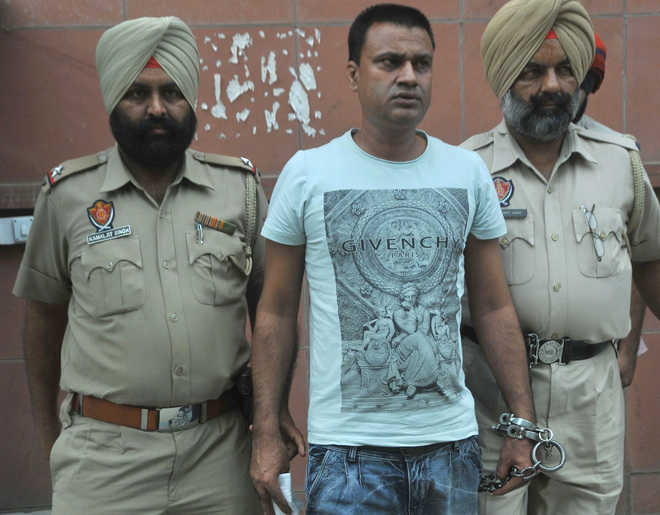
Convict Khushwinder Singh in custody. tribune photo
Fifteen years on, a Punjab and Haryana High Court Division Bench of Justices Rajiv Sharma and Gurvinder Singh Gill today upheld the death sentence for Khushwinder, pronounced by the Mohali CBI special judge.With the CBI probe hitting a dead-end, the case had to be shut in September 2009. But a letter from the Punjab ADGP (Crime) to the CBI in July 2012 led to its reopening. 

The ADGP said Khushwinder, an accused in a similar case of killing of a family where a female member survived, had during investigation confessed to his involvement in pushing to death Kulwant and his family.Speaking for the Bench, Justice Sharma said the motive attributed was that Khushwinder wanted to grab Kulwant’s money from a recently sold property. After developing close ties with Kulwant, who was under debt, Khushwinder persuaded the victim family to accompany him to the crime spot and pushed them into the water. While the bodies of Kulwant and his daughter Ramandeep Kaur were recovered, those of his wife Harjit Kaur and son Arvinder Singh could never be found.
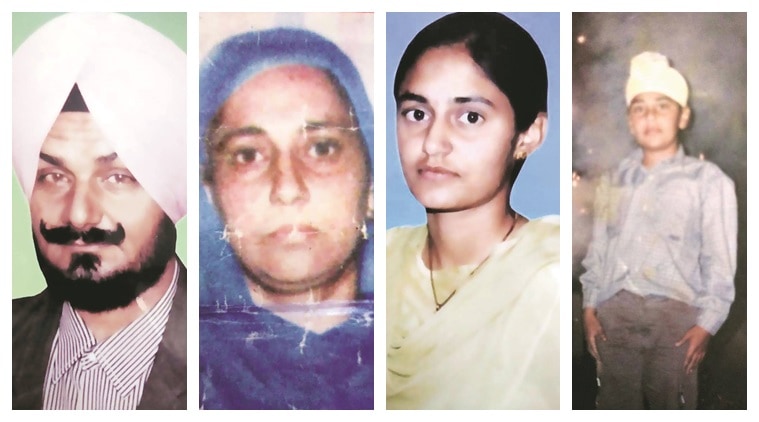
Four members of a family killed (left to right) – Kulwant Singh, Harjeet Kaur, Ramandeep Kaur and Arvinder Singh
“It has been proven on record that the appellant had planned the murder of Kulwant and his family. He pushed them into the Bhakra canal. He has played with the sentiments of gullible family… The case falls within the ambit of rarest of rare cases. The appellant has killed four persons, including two minor children. There is no occasion for us to interfere with the well-reasoned judgment and order of the trial court,” asserted Justice Sharma.

Case files 
  • Khushwinder can still move the Supreme Court, file a mercy petition before the President, and challenge the rejection of that as well
  • In August 2004, Dhananjoy Chatterjee was sent to the gallows for killing and raping a minor in West Bengal 
  • All executions since then have been in terror cases — be it in Parliament attack case (Afzal Guru), Mumbai 26/11 case (Ajmal Kasab) or 1993-Mumbai blasts (Yakub Memon)

Sentenced to death for honour killing, Hisar man set free by HC (Haryana)

Posted at: Apr 7, 2019, 7:00 AM; last updated: Apr 7, 2019, 4:56 PM (IST)
Saurabh Malik
Tribune News Service

Court says prosecution failed to provide credible proof

Chandigarh, April 6, 2019: Less than six months after Ashok, a resident of Hisar district, was sentenced to death in an honour killing case, the Punjab and Haryana High Court has acquitted him. The matter was placed before the Division Bench of Justice Rajiv Sharma and Justice Gurvinder Singh Gill for the confirmation of death sentence pronounced in December last year for poisoning his sister over an inter-caste marriage. Ashok had filed an appeal.

The prosecution contended that Ashok was unhappy with his sister’s marriage to Rohtash. Ashok was charged with administering poison to his sister, resulting in her death. The prosecution had claimed that her body was cremated hurriedly. Justice Sharma said the case record indicated that the police visited the place of occurrence and collected the residue of vomit. Ash and burnt bones were also lifted from the cremation ground before being sent to the Forensic Science Laboratory. Poison did not emerge as the cause of death. 

In any case, the marriage was solemnised in August 2015 and the date of incident was February 13, 2017. The deceased’s cousin, Krishan Kumar, had admitted that there was no resentment in the family. The polygraph test of the parents of the accused showed that the answers given by them were not deceptive. Justice Sharma asserted that Rohtash, on whose insistence an FIR was registered, had not supported the prosecution case. “The chain of circumstances is not complete. The prosecution has failed to prove its case beyond reasonable doubt,” the Bench ruled, while setting Ashok free. 

Key loopholes
  • Contrary to charge, forensic lab report said poisoning was not the cause of death
  • Victim’s cousin testified there was no resentment in family
  • The accused’s parents did not give deceptive answers in the polygraph test

Tuesday, December 25, 2018

High Court abolishes solitary confinement for murder convicts in Haryana jails (Haryana)

Written by Sofi Ahsan |Chandigarh |Updated: December 8, 2018 8:53:15 am 

Removing the provision will require the Punjab government to make amendments to the Jail Manual or for the court, acting on a legal challenge, to quash the provision.

The Punjab and Haryana High Court Friday abolished the practice of keeping death row inmates in solitary confinement in Haryana jails, ruling that it is without authority of law and amounts to additional punishment. The order for abolishing the practice came as part of a judgment commuting the death sentence of three persons convicted last year by a Mahendergarh court for rape and murder of a nine-year-old in 2014 to a mandatory 20-year imprisonment without remissions. The court order for “abolishing” is specific to the “practice” adopted by jail authorities in Haryana, but the division bench of Justices Rajiv Sharma and Gurvinder Singh Gill has not passed any order to remove the provision which forms part of the Punjab Jail Manual which has been adopted by Haryana.

 Justice Gurvinder Singh Gill
Removing the provision will require the Punjab government to make amendments to the Jail Manual or for the court, acting on a legal challenge, to quash the provision. The bench called the provision “anarchic, cruel and insensitive,” reflective of “a colonial mindset” and violative of Articles 20 (2) and Article 21. In a 111-page judgment, the court said the practice amounts to torture and is violative of the person’s basic human rights. “The convict shall not be segregated/isolated till the sentence of death has become final, conclusive and indefeasible which cannot be annulled or voided by any judicial process. The period to keep a convict sentenced to death in segregation/isolation should be for the shortest possible time i.e. 2-3 days.”

 Justice Rajiv Sharma
The judges in the verdict have take note of the research done by American Civil Liberties Union on the medical consequences which people in solitary confinement face, an article published in the Harvard Law Review, a 2005 US Supreme Court judgment, a 1978 Indian Supreme Court judgment and a book on solitary confinement written by Sharon Shalev. The Punjab Jail Manual, according to the judgment, specifies that at present “every prisoner condemned to death is to be confined in a cell apart from all other prisoners and is to be placed by day and by night under the charge of a special guard. No person can communicate with him without the authority of the Superintendent. The prisoner condemned to death is only permitted to occupy the court yard of his cell for half an hour each morning and evening.”

The verdict was passed in the appeals filed by three convicts against the death sentence awarded to them and the murder reference sent by the trial court for confirmation by the High Court. The convicts, according to their advocates, were immediately sent to solitary confinement after being sentenced to death, In November 2014, the nine-year-old victim had been kidnapped by the accused Arun, Rajesh and Deepak when she had gone out with a mouse trap in her hand to drop the mouse outside. She was raped and throttled by the convicts, according to police. “We are of the view that this case does not fall in the ambit of the “rarest of rare case” for awarding death sentence to the appellants. Though according to the final opinion, death is violent but it cannot be termed that it has pricked collective conscious of the society. The young girl was killed by throttling but it cannot be termed gruesome murder,” the bench said, while providing reasoning for commuting the death sentence.

Source: https://indianexpress.com/article/india/high-court-abolishes-solitary-confinement-for-murder-convicts-in-haryana-jails-5484083/ (Accessed 25 December 2018)