Thursday, May 30, 2019

Convicted of Pune rape-murder, two issued execution warrants (Maharashtra)

Written by MAYURA JANWALKAR |Mumbai |Updated: April 21, 2019 3:45:21 am

This will be the first execution in Maharashtra after July 30, 2015, when Yakub Memon, convicted in the 1993 serial bomb blasts case, was hanged at Nagpur Central Prison.

Nearly two years after the President of India rejected their clemency petitions, two men convicted of the rape and murder of a BPO employee in Pune in 2007 are slated to be executed on June 24, according to warrants of execution issued earlier this month.

Convicted of Pune rape-murder, two issued death warrants
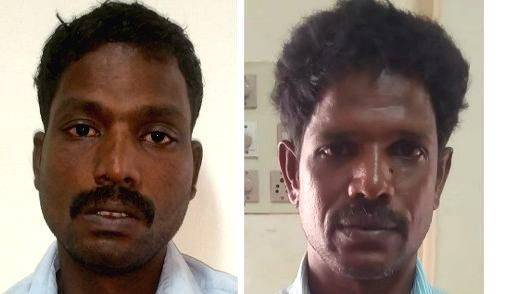
Purushottam Borate (left) and Pradeep Kokade (right) were convicted of the rape and murder of a BPO employee. Express
The principal district and sessions judge in Pune issued warrants on April 10 for the execution of Purushottam Borate, 36, and Pradeep Kokade, 31, whose death sentence was upheld by the Supreme Court on May 8, 2015. Both Borate and Kokade are lodged at the Yerwada Central Prison in Pune. A warrant, issued in the name of Borate, authorises the officer in charge of the Yerwada Central Prison to carry out the execution. Sources said a similar warrant has been issued for Kokade. The victim, Jyotikumari, who hailed from Gorakhpur, had resigned from Wipro BPO (then Spectramind) with whom she had been working for around a year. Around 10 pm on November 1, 2007, her last working day with the company, driver Borate and his friend Kokade had picked her up from her home in the office cab for her night shift. When she did not return by 10 the next morning, her brother-in-law lodged a missing complaint with the police.

Her sister had reported that Jyotikumari’s Bangalore-based friend was unable to get through to her on her cellphone after her call – made during the cab ride – was abruptly disconnected the previous night. Police found her body on the morning of November 2, 2007, at Gahunje, about 35 km from Pune. Borate and Kokade were later arrested. In March 2012, the Pune sessions court convicted the duo and sentenced them to death. The sentence was upheld by the Bombay High Court in September 2012 and by the Supreme Court in May 2015. Maharashtra Governor C Vidyasagar Rao had rejected their mercy petition in April 2016.

This will be the first execution in Maharashtra after July 30, 2015, when Yakub Memon, convicted in the 1993 serial bomb blasts case, was hanged at Nagpur Central Prison.

Post Conviction Mental Illness Is A Mitigating Factor To Commute Death Sentence

BY: ASHOK KINI15 April 2019 1:47 PM

"This Court cautions against utilization of this dicta as a ruse to escape the gallows by pleading such defense even if such aliment is not of grave severity." 

The Supreme Court has held that post conviction mental illness will be a mitigating factor while considering appeals of death convicts. The bench comprising Justice NV Ramana, Justice Mohan M. Shantanagoudar and Justice Indira Banerjee commuted death penalty of a person convicted of rape and murder of two minor girls. The accused was convicted and sentenced to death by the Trial Court in 2001. The High Court confirmed the death sentence. The Supreme Court in November, 2008, dismissed his appeal. Review petitions were also dismissed by circulation. Later, invoking the judgment in Mohd. Arif @ Ashfaq v. The Registrar, Supreme Court of India, he filed petition seeking reopening of review petitions.

Breaking: Post Conviction Mental Illness Is A Mitigating Factor To Commute Death Sentence :SC [Read Judgment]
Justice N.V. Ramana (L), Justice Mohan M Shantanagoudar (C), Justice Indira Banerjee (R)
Two issues were raised in the Review petition. One is that the Trial Court had not given him a separate hearing while awarding the sentence, in direct contravention of Section 235(2) of the Code of Criminal procedure which provides for the right of pre-sentencing hearing. The counsel for the accused also contended that the execution of persons suffering from mental illness or insanity violates Article 21 of the Indian Constitution and that such mental illness or insanity would be a supervening circumstance meriting commutation of the death sentence to life imprisonment.

Regarding the first issue, the bench observed that as long as the spirit and purpose of Section 235(2) is met, inasmuch as the accused is afforded a real and effective opportunity to plead his case with respect to sentencing, whether simply by way of oral submissions or by also bringing pertinent material on record, there is no bar on the pre-sentencing hearing taking place on the same day as the pre-conviction hearing. Depending on the facts and circumstances, a separate date may be required for hearing on sentence, but it is equally permissible to argue on the question of sentence on the same day if the parties wish to do so, the bench added. The bench also considered in detail the question whether post conviction mental illness can be considered a mitigating factor to commute the death penalty. 

The bench observed:
"Considering that India has taken an obligation at an international forum to not punish mental patients with cruel and unusual punishments, it would be necessary for this Court to provide for a test wherein only extreme cases of convicts being mentally ill are not executed. Moreover, this Court cautions against utilization of this dicta as a ruse to escape the gallows by pleading such defense even if such aliment is not of grave severity."
The bench issued these directives: 
  • That the post-conviction severe mental illness will be a mitigating factor that the appellate Court, in appropriate cases, needs to consider while sentencing an accused to death penalty. 
  • The assessment of such disability should be conducted by a multi-disciplinary team of qualified professionals (experienced medical practitioners, criminologists etc), including professional with expertise in accused's particular mental illness. 
  • The burden is on the accused to prove by a preponderance of clear evidence that he is suffering with severe mental illness. 
  • The accused has to demonstrate active, residual or prodromal symptoms that the severe mental disability was manifesting. 
  • The State may offer evidence to rebut such claim. Court in appropriate cases could setup a panel to submit an expert report. 
  • Test of severity' envisaged herein predicates that the offender needs to have a severe mental illness or disability, which simply means that objectively the illness needs to be most serious that the accused cannot understand or comprehend the nature and purpose behind the imposition of such punishment.
In this case, the bench noted that the reports of psychiatrist suggested that the accused has been reeling under bouts of some form of mental irritability since 1994. Commuting the sentence to life imprisonment sans remission, the bench also directed the state to his case under the provisions of the Mental Healthcare Act, 2017 and if found entitled.

SC stays death sentence of Theni man (Tamil Nadu)

NEW DELHI , APRIL 17, 2019 01:12 IST

Warrant has left no time for the convict to file an appeal, says Bench led by Chief Justice

The Supreme Court on Tuesday stayed the execution of a 30-year-old man convicted for killing a college girl and her lover after raping her near Suruli Hills in Theni district in 2011. A Bench led by Chief Justice of India Ranjan Gogoi set aside the warrant of execution issued by the Theni principal sessions judge after the Madras High Court upheld the conviction of Diwakar for murder, and confirmed the death penalty on March 13. The date of execution of the convict, as per the warrant, was April 22.

Diwakar (Theni Murder Case)
The CJI-led Bench noted that the warrant of execution left no time for the convict to file an appeal in the Supreme Court. If implemented, the convict would be executed even before the time allowed under law to file an appeal was exhausted. “The period for filing of a special leave petition/an appeal against the order of conviction and sentence passed is yet to be over, we are of the view that the warrant for execution of death sentence, dated March 27, 2019, 27.3.2019, is contrary to the law,” the apex court held. The Supreme Court further recorded: “We are also told that the petitioner is in the process of filing an appeal. The same as and when filed, will receive due attention of the court”.

In its judgment, the High Court had termed the murder as a “brutal act on the helpless young couple, that too after raping the girl”. “The savageness of the act was shocking and such a person will be a menace to the society,” it had observed. The trial court had sentenced Diwakar to death in March 2018, saying the prosecution had proved its case beyond reasonable doubt.


Thiruvananthapuram: Man murders neighbour, rapes his wife; local court awards death sentence (Kerala)

Updated Apr 12, 2019 | 09:20 IST | Mirror Now Digital

Death sentence was awarded to a man by a local court for murdering another man and allegedly raping the latter's wife. The sentence was awarded to the accused by Mini S Das, additional sessions judge.

Death sentence was awarded to a man by a local court for murdering another man and allegedly raping the latter's wife. The sentence was awarded to the accused by Mini S Das, additional sessions judge. A penalty of Rs 1.75 lakh was also levied on the convict. The alleged incident took place in Koliyoor which falls under the jurisdiction of the Kovalam police station. The incident took place in July 2016. The convict was identified as Anil Kumar alias Kolusu Binu. 

koliyoor-murder-case
 Anil Kumar alias Kolusu Binu & Chandrasekharan
While one of the accused was given a death sentence, the second accused, Chandrasekharan of Tamil Nadu was awarded a life sentence. Chandrasekharan was accused of trespassing, murder, robbery and attempt to murder. A penalty of Rs 1 lakh was imposed on Chandrasekharan. According to the Times of India, the incident took place on July 7, 2016. A man and his wife were sleeping at their residence in Koliyoor when the two accused allegedly attacked him. The husband was attacked with a sledgehammer and an iron rod. The wife was attacked with the same weapon. After attacking the wife, Anil Kumar allegedly raped her. 

The woman went into a coma due to brain damage. Though the woman gained consciousness, her memory was lost. The accused then ransacked the house and robbed the couple of their valuables. The crime came to light after the children of the deceased woke up after a few hours. The accused were booked under relevant sections of the Indian Penal Code (IPC). The case of the prosecution was being handled by Special public prosecutor VS Vineeth Kumar. Since the case did not have any eye witnesses, the decision was taken on the bases of circumstantial and scientific evidence. Anil Kumar was the neighbour of the deceased and shared a friendly equation with them. Kumar had made several attempts towards the victim but after she refused, he decided to commit the crime. 

Persuasive argument against death penalty (Book)

THE ASIAN AGE. | JAYANT TRIPATHI
Published : Apr 7, 2019, 3:47 am IST

In India, from the time of Raja Nand Kumar’s case (1775) to the decision of the Supreme Court in the Bachan Singh case (1980).

Demons and Demigods: Death Penalty in India, by Aparna Jha Oxford University Press, Rs 495.
In the interests of fair disclosure, I should, at the outset, state that I believe that the legal system, with its scheme of graded punishments, with different punishments set out for different crimes, is fair and just, and that includes the imposition of capital punishment for certain crimes. And yet, I am now reviewing a book that is opposed to the imposition of capital punishment. 

Aparna Jha, a lawyer practising in the Supreme Court, has drawn upon her experience as a lawyer for four young death row convicts, telling their story, and the story of the research carried out by her during the case, to come out with an eminently readable book. 

The author, who has written an anthology of short stories as well as a novel, has used her skills as a storyteller to take us through some of the leading cases on the death penalty, describing the actual crimes and associated violence in an almost poetic manner. She makes no attempt to mitigate the severity of the violence that was inflicted upon the deceased, with gruesome details being penned down. And yet, the author believes that the perpetrators of such violence deserve to live, that the death penalty, being nothing but state-sanctioned murder, is wrong, and makes out an impassioned case for not depriving a human being of life. As the last words in the book say if a person is subsequently found innocent, “Can they ever be brought back to life? Then why kill them?”

“The quality of mercy” to quote the Bard, is “…an attribute to God himself”. Mercy, however, cannot absolve the guilty, it merely mitigates the punishment. Over the centuries debate has raged about the desirability or efficacy of the death penalty. Opponents and proponents of the penalty have clear battlelines drawn between them. In India, from the time of Raja Nand Kumar’s case (1775) to the decision of the Supreme Court in Bachan Singh case (1980), the application of the death penalty has travelled from being the fitting punishment for the crime of forgery to a punishment in the exceptionally heinous “rarest of the rare” murders. And now the debate has moved on from the death penalty as a punishment in the rarest of the rare cases, to the abolition of the punishment altogether.

There is no crime in India where the only possible punishment is death. The gravest offences such as murder, mutiny, rape and killing of a child below 12 years of age, abetment of suicide of a minor, abetment of sati, etc., carry the death penalty. However, in all of these cases, the death penalty is one of alternate punishments. The law takes into account that for the same offence, different punishments may be possible. In other words, there is already an inherent protection for the wrong-doer to plead mitigating circumstances to seek a lower penal consequence.

The application of the death penalty has been diluted further still by judicial pronouncements, and now it is only in the rarest of the rare cases, after considering all mitigating circumstances that the penalty is awarded. 

Take for example one of the cases discussed in the book — the case of Dhananjoy Chatterjee, a young security guard in an apartment complex in Kolkata, who raped and murdered a teenaged school-going girl who lived in the apartments which he was supposed to guard. There were no eyewitnesses to the murder, but the circumstantial evidence was so strong that the death penalty was upheld by the Supreme Court. In a case where a young girl is savagely murdered by the very man who is supposed to protect her, should issues of the poverty of the parents of the murderer, or the possibility of reform, be factors to reduce the sentence to life imprisonment? The author thinks they should. But the author’s argument is based on a moral premise that to kill is wrong, and the killing of Dhananjoy Chatterjee by the state is as wrong as Dhananjoy Chatterjee’s killing of the girl who had her whole life ahead of her.

The morality of the law is a subject which is once again contentious and the source of a never-ending debate. However, the fact remains that the death penalty is on the statute books, and till such time it remains there, it is the bounden duty of courts to administer it, within the parameters of the law and judicial precedent. For a judge of any court, even the highest, to say that he or she would not sentence a person to death on moral principles, would be reducing the law to mere words on paper, reducing its efficacy and setting a precedent that may have severe repercussions. On the other hand, if the civil society was able to convince parliamentarians that the death penalty should be removed from the statute books, that would be a completely different thing. 

If you are looking for a book that contains an intellectual debate on the pros and cons of capital punishment, drawing upon the various theories of punishment and justice, and citing facts and figures, this book is not it. It is, however, a useful starting point for an overview on the subject, since the author does refer to other points of view as well as some of the global perspectives on the death penalty, albeit from her point of view. 

The interesting thing is that this book made me pause, introspect and review my thoughts and stand on capital punishment. I would say that any book that can make any other person review his or her own beliefs, deserves to be read, whether you agree with it or not. My views are still unchanged, but reading the book did make me think again.

The reviewer is a lawyer practising in Delhi.
Sentenced to death for honour killing, Hisar man set free by HC (Haryana)

Posted at: Apr 7, 2019, 7:00 AM; last updated: Apr 7, 2019, 4:56 PM (IST)
Saurabh Malik
Tribune News Service

Court says prosecution failed to provide credible proof

Chandigarh, April 6, 2019: Less than six months after Ashok, a resident of Hisar district, was sentenced to death in an honour killing case, the Punjab and Haryana High Court has acquitted him. The matter was placed before the Division Bench of Justice Rajiv Sharma and Justice Gurvinder Singh Gill for the confirmation of death sentence pronounced in December last year for poisoning his sister over an inter-caste marriage. Ashok had filed an appeal.

The prosecution contended that Ashok was unhappy with his sister’s marriage to Rohtash. Ashok was charged with administering poison to his sister, resulting in her death. The prosecution had claimed that her body was cremated hurriedly. Justice Sharma said the case record indicated that the police visited the place of occurrence and collected the residue of vomit. Ash and burnt bones were also lifted from the cremation ground before being sent to the Forensic Science Laboratory. Poison did not emerge as the cause of death. 

In any case, the marriage was solemnised in August 2015 and the date of incident was February 13, 2017. The deceased’s cousin, Krishan Kumar, had admitted that there was no resentment in the family. The polygraph test of the parents of the accused showed that the answers given by them were not deceptive. Justice Sharma asserted that Rohtash, on whose insistence an FIR was registered, had not supported the prosecution case. “The chain of circumstances is not complete. The prosecution has failed to prove its case beyond reasonable doubt,” the Bench ruled, while setting Ashok free. 

Key loopholes
  • Contrary to charge, forensic lab report said poisoning was not the cause of death
  • Victim’s cousin testified there was no resentment in family
  • The accused’s parents did not give deceptive answers in the polygraph test

Koli gets 11th death sentence in Nithari murder case (Uttar Pradesh)

06 APRIL 2019 Last Updated at 7:36 PM | SOURCE: IANS

Ghaziabad, April 6 A CBI court awarded death sentence -- 11th -- to Surender Koli in the Nithari serial killing case, here on Saturday.

CBI Prosecutor J.P. Sharma said it was the 11th case in which Koli has been ordered to be hanged till death. But the court acquitted the co-accused Maninder Singh Pandher, due to lack of evidence. According to Sharma, a 10-year-old girl went missing after she had gone to deliver 'ironed' cloths at D-5, residence Pandher, where his domestic help Koli was living, on June 21, 2005. When the girl did not return home for two days, her parents lodged a complaint at Sector 20 police station on June 23, 2005.

Surender Koli (L); Maninder Singh Pandher (R)
The case was handed over to the CBI on June 11, 2007 and the agency submitted chargesheet on April 9, 2008. The court of special judge Amit Vir Singh held Koli guilty on Friday. On Saturday, the court awarded a death sentence to Koli and imposed a penalty of Rs 1.10 lakh on him. The court, however, acquitted Pandher for lack of credible evidence. On December 26, 2006 the Noida Police had recovered scull from the back of the house. In a DNA test, it was established that the scull was of the missing girl. The DNA report became most crucial evidence against Koli.

Thirty-eight witnesses testified in the case.