Showing posts with label Bombay High Court. Show all posts

Wednesday, May 29, 2019

Bombay High Court: Was death row man allowed phone call? (Maharashtra)

Shaikh, held guilty of conspiracy in the 2006 serial train bombings, was sentenced to death by a special MCOCA court.

Feb 27, 2019, 06:25 AM IST

The Bombay High Court has asked prison authorities to reply by Thursday on whether they allowed death row convict Faisal Shaikh to make a phone call to his mother from inside the prison. Shaikh, held guilty of conspiracy in the 2006 serial train bombings, was sentenced to death by a special MCOCA court. A division bench of justices Abhay Oka and AS Gadkari, while rejecting emergency parole leave sought by Shaikh, had asked the Yerwada prison authorities earlier this month to consider his application to allow him to speak to his aged mother. The application was made on January 14, soon after prison authorities rejected his parole application.
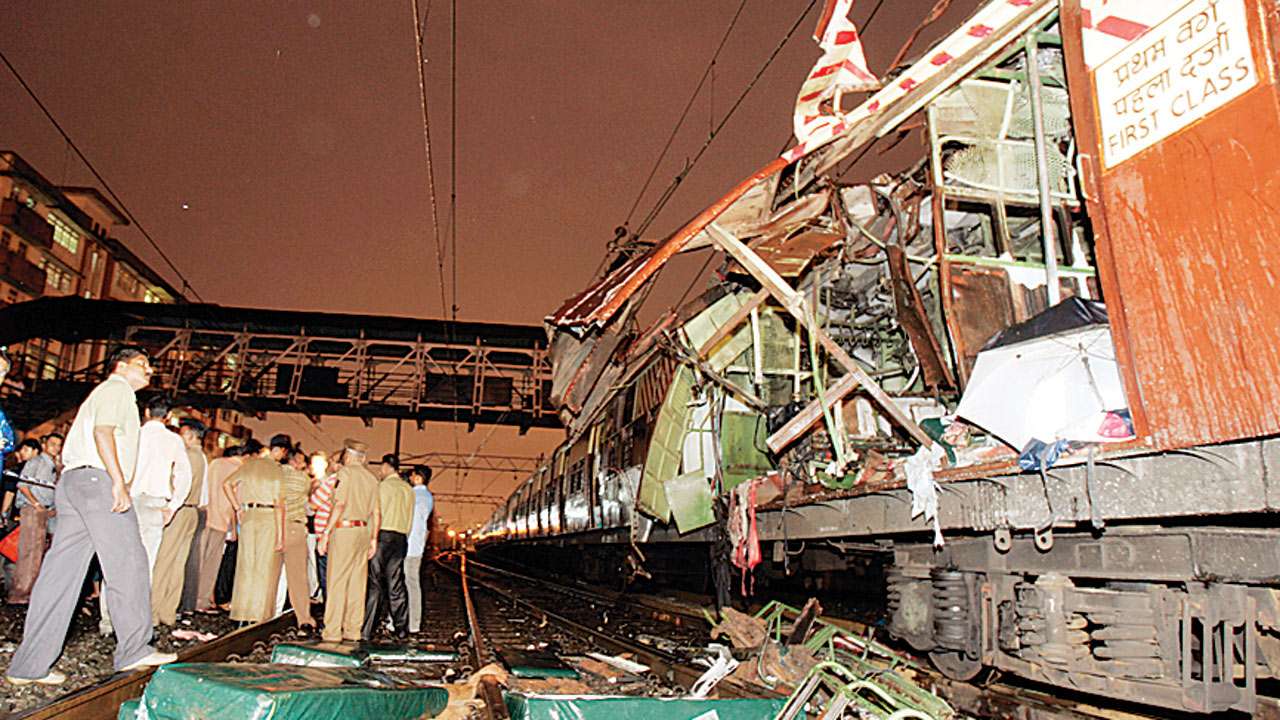
2006 train blasts
2006 train blasts 188 lives were lost in the 2006 blasts
Advocate Farhana Shah, appearing for Shaikh, argued that Shaikh "could have been taken in police escort as parole was sought on grounds of his father's death". However, the prosecution opposed the plea, saying cases of all convicts except foreigners and those on death sentence can be considered for grant of emergency parole. The court agreed with the prosecution's contention. However, as regards the request for a phone call to his mother, the bench said, "We are surprised to note that this application is pending since January 14. Considering the nature of the request, immediate consideration of the application is mandatory." Shaikh is one of 12 persons convicted in the blasts case. He is alleged to have worked with Azam Cheema, LeT commander-in-chief, and is alleged to have received arms training in Pakistan.

Black Tuesday
Seven serial blasts had ripped through Mumbai’s local trains on July 11, 2006. 188 persons died while 817 were injured. Five persons were sentenced to death while seven were given life imprisonment. One person was acquitted.

Saturday, December 29, 2018

Is capital punishment effective in bringing down crime rates?

written by Narsi Benwal December 29, 2018

Mumbai: Even if the death sentence is legal and constitutionally valid, it is not the punishment for any crime. The history has proved how capital punishment has failed to be deterrent in the society as, despite convicts being hanged, crimes continue to take place in the society.

The debate on the abolition of death sentence has caught pace once again after the Bombay High Court, last week, confirmed the capital punishment of Chandrabhan Sanap, who had raped and killed Esther Anuhya, a software engineer. The judgment delivered by the bench of Justices Ranjit More and Bharati Dangre also refers to the observations of Justice Kurien Joseph of the Supreme Court, who sparked the latest debate on the death sentence. In a judgment, Justice Joseph delivered on his retirement day, he expressed the need of the hour to review the if death penalty as a punishment is necessary, especially its purpose and practice.’

The death sentence is vehemently opposed by advocate Navkiran Singh, a human rights lawyer, who thinks India will require at least one century for abolishing capital punishment. While speaking exclusively to The Free Press Journal, Singh said, “No punishment is deterrent to others as nobody cares. Why kill? Will hanging a person bring down the crime rates? The problem is we are not trying to find out the reasons as to why people are resorting to crime.” “We as a society are too good than that of western countries. At least our rehabilitation system still works. We do not have a large number of repeat offenders as compared to that of the western world. Still, we are continuing with this punishment whereas they (western countries) have abolished it,” said Singh, the general secretary of Lawyers for Human Rights International (LHRI).

The LHRI is a worldwide organisation fighting for human rights. It strongly demands the abolition of death punishment from India. According to Singh, Indians need to learn from Rahul and Priyanka Gandhi, who pardoned the killers of their father and former PM Rajiv Gandhi. “We live in a country where reactions are immediate. Ours is an immature democracy. We need to learn a lot from Rahul and Priyanka (Gandhi) how they pardoned killers of their father. I think making citizens understand this will take another century,” Singh added. “One has to look at the fact that even if death sentence is imposed on certain persons, will the crime rates come down? Take example of Delhi gang rape case wherein death has been pronounced and even confirmed by the top court. Still we can see rape cases being reported daily,” Singh said.

Justice (retd). P B Sawant of the Supreme Court, however, thinks death sentence must be given only in specific cases which leaves no room for any other punishment. “I believe death is the only punishment for serial killers, contract killers and so on. These are basically persons who do not think or hesitate even for a second before killing a human being. Such people deserve such a punishment,” Justice Sawant said. Justice Sawant further opined that in cases of gang rape or death after rape, death sentence is the only option. “Such offences need to be stopped and the same can be stopped only when most deterrent punishment is imposed on the wrong doers. Also, even if one accept the argument that there can be an alternative to death sentence, I do not think there can be a stern punishment than this,” said Justice Sawant, who had sent a serial killer to gallows in 1970s, when he was the judge of the Bombay High Court. “There is no other punishment as stern as death. Also, there is no point in letting such people live in the jails. Thus, death sentence cannot be totally abolished,” Justice Sawant said.

Source: https://www.freepressjournal.in/mumbai/is-capital-punishment-effective-in-bringing-down-crime-rates/1424515 (Accessed 29 December 2018)

Sunday, December 23, 2018

High court commutes capital punishment to life (Maharashtra)

TNN | Mar 26, 2017, 12.01 AM IST 

AURANGABAD: The Aurangabad bench of the Bombay high court has set aside the capital punishment awarded to a 32-year-old man for murdering his wife in 2014 and commuted his sentence to 30 years of imprisonment. The court acquitting three others in the case. On the intervening night of July 24 and 25 in 2014, Nitin Balkisan Gaikwad, who worked as a driver, murdered his wife, Pranitha, by stabbing her 21 times at the staff quarters of the Dhule-based Agricultural College. After Gaikwad did not report to duty, college employees went to their residence to check on them and found the door locked from inside. On breaking open the door, they found Gaikwad and his wife in a pool of blood. Police also recovered a suspected suicide note by him, blaming Pranitha’s father for taking a loan of Rs 7 lakh from him and not returning it. The two had been married for a couple of months before the incident.

On November 10, 2016, a lower court awarded the death sentence to Gaikwad, while his mother and two brothers were convicted for dowry harassment. They were sentenced to one month of rigorous imprisonment. While commuting the death sentence, the division bench comprising Justice S S Shinde and Justice K K Sonawne ruled that Gaikwad had pre-planned the murder and struck with extreme brutality. The circumstances on record show the murder was diabolical, cold-blooded and cruel, they said. They also said the accused had no regard for human life, or feelings of humanity or compassion for the woman. It further added that there were a few mitigating circumstances in favour of Gaikwad. Their neighbour, a witness during his cross-examination, had said the relationship between Gaikwad and Pranita was cordial. 

Another crucial witness, Pranitha’s father, had said that she wanted to stay with Gaikwad. The division bench, citing parameters applied by the Supreme Court and also the absence of criminal antecedents/past criminal record of the accused and the age of the accused, set aside the capital punishment. Lawyer Joydeep Chatterji, representing the four accused in the case, said, “The allegations about cruelty against the accused were too vague and generalized.” The lawyer also said that the judges gave the benefit of doubt to the other three accused in the case as it was on record that none of them were residing with the couple on the day of the incident. They were residing at Rahuri. The lawyer also said police failed to probe the elements of the suspected suicide note.

Source: https://timesofindia.indiatimes.com/city/aurangabad/hc-commutes-capital-punishment-to-life/articleshowprint/57832658.cms (Accessed 23 December 2018)

Thursday, December 20, 2018

German bakery blast: State challenges Bombay HC verdict converting Baig’s death penalty to life (Maharashtra)

By Express News Service |Pune/new Delhi |Published: July 1, 2016 12:20:57 am

Government has also taken objection to the HC’s remarks on terror operative Yasin Bhatkal in this case. The Maharashtra government on Thursday moved the Supreme Court (SC), seeking death penalty for Mirza Himayat Inayat Baig (32), the lone convict in the German Bakery blast in Pune, which had claimed 17 lives on February 13, 2010. The appeal filed through state government’s standing counsel Nishant R Katneshwarkar challenged the Bombay High Court (HC) verdict that had commuted Baig’s capital punishment to life term.

It also challenged Baig’s acquittal under various sections of the Unlawful Prevention (Activities) Act and the IPC, including Sections 302 (murder) read with 120-B (criminal conspiracy), by the High Court. The High Court has given life term to Baig, 32, under the Explosive Substances Act. The state has also taken objection to the HC’s remarks on terror operative Yasin Bhatkal in this case. The ATS had arrested Baig, a native of Beed district of Maharashtra, on September 7, 2010, from Pulgate area of Pune for his alleged involvement in the German Bakery blast. 

German bakery blast convict Himayat Baig (Photo Deccan Chronicle)
On April 18, 2013, the sessions court in Pune awarded death sentence to Baig, holding him guilty under Sections 10 (b), 16 (1)(a) of UAPA, Sections 302, 120 (b) of IPC and Section 3 of Explosives Substances Act. Baig moved the HC against the lower court order, and on March 17, this year, the HC, while setting aside Baig’s death sentence, acquitted him from charges under Sections of UAPA, Sections 120 (b), 302 of IPC and Section 3 (b) of the Explosive Substances Act, 1908.

The court granted him life term, holding him guilty under Section 5 (b) of the Explosive Substances Act, and seven years’ imprisonment as charge under Section 474 of IPC was confirmed. Speaking to The Indian Express, special public prosecutor Raja Thakre confirmed that the state had filed an appeal in SC against the Bombay HC order. “We have challenged the acquittal orders of the HC on certain sections against Baig. We also have raised objections on the remarks of the HC on Yasin Bhatkal. We have appealed to the SC that these remarks be expunged from the records,” said Thakre.

According to ATS, the bakery blast conspiracy was hatched in Colombo in 2008 and finalised in Udgir in Maharashtra in January 2010. The chargesheet said that Baig was the alleged LeT commander for Maharashtra. ATS has alleged that Baig had gone to Colombo in March 2008 to discuss the plan with Fayyaz Kagzi and Zabiuddin Ansari and “the diabolic design to cause further terrorist activities was finalised” there. Baig was allegedly trained by the duo to build an explosive device and explode it. They are also suspected to have given him money for explosive devices and travel of Muslim youth indoctrinated for terror training.

On February 13, Baig and Yasin allegedly carried the explosive device in a private vehicle from Udgir to Latur and in a state transport bus from Latur to Pune. The duo then hailed an autorickshaw to travel from Poolgate bus stand to Pune Railway Station and from there they went to Central Mall in another autorickshaw. “Yasin planted the bomb in a haversack at the bakery around 5 pm and triggered it with the help of a mobile triggering device at 6.50 pm,” the chargesheet stated.

Meanwhile, ATS claimed that Yasin Bhatkal was seen in the CCTV footage obtained from the blast site. Later, the National Investigation Agency (NIA) took over the probe into the case. In June 2012, the accused Zabiudding Ansari alias Abu Jundal was deported from Saudi Arabia to India. In August 2013, the accused Yasin Bhatkal was held on the India-Nepal border. In March 2014, ATS formally arrested Yasin in the German Bakery blast case and filed a supplementary chargesheet against him in August.

Source: https://indianexpress.com/article/india/india-news-india/german-bakery-blast-state-challenges-bombay-hc-verdict-converting-baigs-death-penalty-to-life/ (Accessed 20 December 2018)

Bombay High Court reduces death penalty to life imprisonment of youth who raped and murdered his 4-year-old niece

Mar 15, 2016, 06:50 AM IST

The Bombay High Court on Monday commuted the death sentence of a 21-year-old youth who was sentenced death penalty for raping and murdering his four-year-old niece in 2012 at Sangli. The court thus sentenced the accused to suffer life imprisonment for both the charges which would run consecutively.

A division bench of justices VK Tahilramani and AS Gadkari reduced the sentence of Vithal Atugade who is lodged in prison ever since his arrest in 2012. The court while reducing the sentenced accepted the defense advocate Abhay Apte's argument that the accused was of tender age and belonged to an economically weaker section of the society. Public prosecutor Geeta Mulekar said the accused was the first cousin of the victim's mother. On the day of the offence he told the victim's mother that he was going to a saloon and taking her with him. Then he took her to a secluded place and raped her, for four hours he waited for the victim to die on her own. But when it did not he dragged her away for two kilo meters and buried her.

The mother of the victim lodged a missing complaint with the police and informed that the victim was last seen with the accused. Based on which the accused came to be arrested two days after and during interrogation he confessed to have committed the crime. He also showed the place of the burial, police exhumed the body and the victim was identified through her clothes and ornaments. During the trial, the prosecution examined 23 witnesses to bring home the guilt of the accused and based on the testimony of the witnesses and the medical evidence the sessions court in Sangli handed down the death penalty to the accused. This came to be challenged by the accused in the high court and the state also moved the court for confirming the death sentence.

Apte said the court has accepted my argument that the incident was not premeditated and considered the young age as a strong mitigating circumstance to reduce the sentence from death to life imprisonment.

Source: https://www.dnaindia.com/mumbai/report-bombay-high-court-reduces-death-penalty-to-life-imprisonment-of-youth-who-raped-and-murdered-his-4-year-old-niece-2189272 (Accessed 20 December 2018)

Wednesday, December 19, 2018

Germany Bakery blast case: Bombay HC reserves order on death sentence to accused

Dec 22, 2015, 10:35 PM IST

The Bombay High Court has reserved its judgement on the confirmation of death sentence awarded to Himayat Baig, the lone convict in the 2010 German Bakery blast case. The arguments before the bench of Justices Naresh Patil and S B Sukhare ended on Tuesday. The Pune sessions court had in April 2013 sentenced Baig to death for the blast at the German Bakery eatery in the Koregaon Park area of Pune in February 2010 which claimed 17 lives and left 58 people including some foreigners injured.

While a death sentence has to be confirmed by the HC, Baig has also filed appeal against the conviction and the sentence. The confirmation petition and the appeal were heard simultaneously by the High Court. Special prosecutor Raja Thakre argued that there was enough circumstantial evidence to form a complete chain of events leading to the blast, and the testimony of witnesses was corroborated by the documentary evidence which was not disputed. The defence didn't dispute the chemical analyser's report confirming that traces of the explosive substance RDX found at Baig's house and that found at the Bakery chemically matched.

German Bakery, Pune 
A Delhi forensic laboratory where CBI had sent samples and the one in Pune where the ATS had earlier sent the samples reached the same conclusion, Thakre pointed out. Baig's lawyer Mahmood Pracha argued that the lawyer who defended Baig in the trial court had been "thrust" upon him by the ATS which had concocted the whole case." Pracha demanded a retrial, or a recall of two witnesses who had alleged that they were forced to depose against Baig.

Baig was not in Pune on the day of the blast but in Aurangabad, advocate Pracha said, adding that the `RDX' showed as recovered at Baig's behest was not proved to be an explosive substance. He also alleged dicrepancies in documents including the station diary that recorded the finding of RDX.
Source: https://www.dnaindia.com/mumbai/report-germany-bakery-blast-case-bombay-hc-reserves-order-on-death-sentence-to-accused-2158680 (Accessed 19 December 2018)

HC confirms death sentence for rapist-killer

Printed from MUMBAI:
Oct 15, 2015, 01:21 IST

Bombay high court on Wednesday upheld the conviction of a Bhayandar resident for a heinous rape and murder of a six-year-old girl and confirmed a death sentence awarded by a trial court. The convict had throttled the child to death after raping and breaking her vertebrae bone in June 2010.A bench headed by the acting Chief Justice Vijaya Kapse-Tahilramani agreed with the public prosecutor, Prajakta Shinde, that it was a “cold-blooded crime so heinous that it merits death sentence as it falls in the rarest or rare category”.

The HC observed that the “rising crime wave” against women and children has to be tackled seriously and earnestly. A Thane sessions court had earlier this year convicted a 29-year-old labourer Prakash Kewat for being the rapist and murderer. Kewat who resided in a Bhayandar slum and worked in a company in Vasai had raped and throttled the child to death. The girl, had left her house at 9pm on June 11, 2010, and was found only the next day at 7am, naked, in a nallah, her body covered with bruises, her vertebra fractured. At first the police had registered a case of drowning. But investigation by investigating officer Deepak Devraj led to a proper FIR of rape and murder. The evidence in the case was clinching said Shinde. '

A house search showed blood-stained articles including cardboard box, tiles, pillow covers and his clothes, which matched the DNA and blood of the victim. Doctors deposed that the small body was covered with 15 injuries and her vertebra was fractured. Such injuries were not from a fall as the defence suggested.

Source: https://timesofindia.indiatimes.com/City/Mumbai/HC-confirms-death-sentence-for-rapist-killer/articleshow/49360951.cms (Accessed on 19 December 2018)

Friday, February 6, 2015

SC extends stay on Yaqub Memon’s death sentence


New Delhi, Sep 26 : The Supreme Court Friday stayed execution of the death sentence of 1993 Mumbai bomb blast convict Yakub Abdul Razak Memon as it issued notice to Maharashtra government on his petition seeking an open court hearing of his plea for the review of the apex court’s verdict upholding his death penalty.
Yakub Memom 

 Extending the June 2 order suspending his death sentence, a bench of Justice T.S.Thakur, Justice S.A. Bobde and Justice R. Banumathi in their order said that the execution of the death sentence will be stayed. Seeking the revival of his review petition, which was earlier dismissed after being considered in the chamber by the judges, Memon relied on Sep 2 verdict of the apex court’s constitution bench which had held that a petition seeking the recall of the apex court’s order upholding the death sentence will be heard in an open court by a bench of three judges. The constitution bench in its Sep 2 order had also said: “It will also apply where a review petition is already dismissed but the death sentence is not executed so far. In such cases, the petitioners can apply for the reopening of their review petition within one month from the date of this judgment.” 

Memon is the second death row convict whose plea for recall of the order upholding the death sentence is being revived after it was dismissed earlier. On Sep 12, the court had fixed Oct 29 for an open court hearing of Nithari serial killer death row convict Surendra Koli’s review plea which had also been dismissed earlier. The Supreme Court March 21, 2013, had upheld the death sentence awarded to Memon by the special (now lapsed) TADA (Terrorism and Disruptive Activities Prevention Act) court and confirmed by the Bombay High Court. Memon has been described as a mastermind of 1993 Mumbai bomb blasts – a series of 13 explosions in India’s business capital March 12, 1993, which claimed 257 lives and left 713 injured. President Pranab Mukherjee May 21 rejected Memon’s mercy plea. He applied for presidential pardon in October 2013. 

The TADA trial court presided over by Justice P.D. Kode had commenced the trial Nov 4, 1993, and pronounced its 4,230-page verdict July 31, 2007. The trial court awarded death sentence to 12 people, including Memon. One of them subsequently passed away. The trial court had also sentenced 20 people to life imprisonment and 46 others, including Bollywood star Sanjay Dutt, were given varying terms of imprisonment. (IANS) Source: http://odishasuntimes.com/89138/sc-extends-stay-yaqub-memons-death-sentence/ [last accessed 06.02.2015]

Bombay HC Confirms Death Penalty for Pune Rogue Driver


By IANS Published: 09th September 2014 02:35 PM Last Updated: 09th September 2014 03:03 PM MUMBAI: The Bombay High Court Tuesday confirmed the death sentence on Pune rogue driver Santosh M. Mane, who two years ago hijacked a state transport bus and killed nine people. The incident happened Jan 25, 2012 after he was denied a change from night duty to day duty by his superiors. In a fit of rage, he hijacked the bus from the busy Swargate Bus Depot in the heart of the city and drove wildly for nearly 16 km before he was forced to a stop. The incident left nine pedestrians dead, many were injured and several private and government vehicles as well as public and private property en route were damaged. Source: http://www.newindianexpress.com/nation/Bombay-HC-Confirms-Death-Penalty-for-Pune-Rogue-Driver/2014/09/09/article2422576.ece [last accessed 06.02.2015]

Can public outcry justify punishment? HC asks in Pune driver


Press Trust of India | Mumbai August 5, 2014 Last Updated at 20:19 IST Hearing the arguments on death penalty awarded by a lower court to Pune-based bus driver Santosh Mane, the Bombay High Court today asked the government to justify if "public outcry" should be a factor in deciding the quantum of punishment. Mane, a former driver with state transport, had mowed down nine people in Pune in a fit of maniacal driving in January 2012. The division bench of Justices V M Kanade and P D Kode is hearing state's plea for confirmation of his death sentence, as well as his appeal against the sentence. The court today also sought to know from the government if there was any possibility of the convict being reformed if his life was spared. The judges asked government pleader S S Shinde to cite previous judgements of the Supreme Court in favour of reformative punishment. On January 25, 2012, Mane had hijacked an empty bus from Swargate depot and drove it like a madman until the police and some passers-by caught up with him and stopped him. While the state has sought confirmation of death penalty saying that he committed a serious crime against the society, Mane's lawyer, advocate Jagdish Mane, sought leniency, considering that Santosh has a wife, two children and parents to look after and also because he is "mentally sick". The High Court has already upheld his conviction. Advocate Mane also argued that police suppressed the fact during the trial that Santosh was undergoing treatment for mental illness. The defence also pleaded insanity and sought Santosh's re-examination by a psychiatrist but the High Court turned down the plea. The arguments will continue tomorrow. Source: http://www.business-standard.com/article/pti-stories/can-public-outcry-justify-punishment-hc-asks-in-pune-driver-114080501683_1.html [last accessed 06.02.2015]

Sunday, June 30, 2013

Baig files appeal in HC against death sentence - Pune sessions court had handed down five-time death sentence to the Indian Mujahideen operative from Beed two months ago

Vijay ChavanPosted On Friday, June 21, 2013 at 08:06:04 AM

Two months after being awarded a five-time death sentence, Indian Mujahideen (IM) operative from Beed, Mirza Himayat Inayat Baig (32), has filed an appeal in the Bombay High Court (HC) against his conviction by the Pune sessions court.

Considering it as the rarest or rare crime, the court of additional sessions judge N P Dhote had awarded the death sentence to Baig on April 18 for playing a major role in the blast at the German Bakery blast on the busy North Main Road in Koregaon Park.

The blast, that had ripped through the popular eatery on February 13, 2010, had killed 17 people and injured over 60 others. Baig filed the appeal through his lawyers, advocates A Rehman and Kainat Shaikh.

Shaikh confirmed that they have filed the appeal, adding, “We are waiting for the HC to admit the appeal on the next date, which is yet to be confirmed. We are hopeful that the judicial procedure will be completed as soon as possible to give some relief to the convict with reduction in the sentence awarded to him.” Shaikh said, “Baig is yet to receive notice from the HC since the state government has filed an application of confirmation of his death penalty.

As per rules, this is mandatory.” On being asked about the grounds on which the appeal has been filed, Shaikh said it would be too soon now to reveal all the details that they are going to put before the court during the appeal hearing.

The court had awarded the capital punishment to Baig under sections 302 and 120(B) of the Indian Penal Code (IPC), 16(A) of Unlawful Activities (Prevention) Act (UAPA), and section 3 of Explosive Substances Act.

Baig, the lone arrested accused, was found guilty of terrorist activities such as planting the bomb and hatching a conspiracy against the nation. The court had accepted the prosecution’s contention that it was a “carefully planned and executed attack, calculated to terrorise the public in general by causing extensive damage to life and property.

Its primary objective was to undermine and reduce faith of the common citizen in the elected government and destabilise the system of law”.


Main culprits still at large.

The ATS has named six other accused —Ahmad Siddibappa Zarar alias Yasin Bhatkal, Riyaz Ismail Shahbandri alias Riyaz Bhatkal, Iqbal Ismail Shahbandri alias Iqbal Bhatkal, Mohsin Choudhary, Fayyaz Kagzi alias Zulfikar Fayyaz Ahmad and Sayyad Zabiuddin Sayyad Zakiuddin Ansari alias Zabi. Ansari was recently arrested in the 26/11 Mumbai terror attack case.

Source : http://www.punemirror.in/article/2/2013062120130621080610324333dd325/Baig-files-appeal-in-HC-against-death-sentence.html?pageno=1

Thursday, May 16, 2013

High Court admits Mane plea against death penalty

 
Santosh Mane, the state transport bus driver who was awarded death penalty in a road rage case, has moved the Bombay High Court challenging the sessions court verdict. A plea filed by lawyer Jaideep Mane on the convict’s behalf was admitted by the high court on May 9.
A bench of Justice V K Tahilramani and Justice P D Kode will hear the case.
“The hearings in the high court will start in July. We were not happy with the outcome of the trial in the sessions court. The accused was not even given an opportunity to present his side as per the provision before he was awarded the death penalty. We are hoping that the high court will take a lenient view on account of the mental unsoundness of the accused,” said advocate Jaideep Mane.
On April 8, Mane was awarded the death sentence by an additional sessions judge who declared his crime as rarest of the rare. He was convicted under Sections 381, 302, 307, 324 and 427 of the Indian Penal Code (IPC).
On January 25 last year, Mane hijacked an ST bus from Swargate depot and went on a rampage, killing nine people and injuring 37 besides damaging over 25 vehicles.
During the course of trial while the prosecution maintained that Mane was in a complete sound state of mind when he committed the crime, the defence had claimed that Mane was suffering from a psychiatric disorder when he committed the act and should be given advantage under Section 84 of the IPC. The defence had also produced a Solapur-based psychiatrist Dr Dilip Burte before the court who claimed to have treated Mane for ‘mania’ for a period of over one year.
However, the court held that Mane visited Burte’s clinic just once and that Burte falsified the records to help the defence. The court had also served a notice on Burte for misleading the court.
Burte’s lawyer recently submitted in the court that whatever he said and the documents he submitted were true and bore his signatures.

Source : http://m.indianexpress.com/news/high-court-admits-mane-plea-against-death-penalty/1115038/

HC commutes death penalty of 2 to 30-year jail term


BOMBAY High Court Tuesday set aside death penalty of two persons who kidnapped and murdered a four-year-old boy in Navi Mumbai in 2004. The court sentenced both convicts to 30 years’ imprisonment.
A division bench of Justices V M Kanade and P D Kode held that the case could not be included in the “rarest of rare” category as laid down by Supreme Court. The death sentence was awarded by a sessions court in March last year.
The accused — Nihal Ahmed Shaikh and Rafiq Mohammed Sayyed — are said to have kidnapped the boy, Nitesh Wadhwa- on April 24, 2004, from his residence in Vashi. A month later, police found Nitesh’s body of Nitesh after the accused were arrested. The accused had demanded a ransom of Rs 5.5 lakh from the boy’s father, Prakash Wadhwa.
“We are of the considered opinion that in the facts and circumstances of the instant case, it cannot be said to be of a rarest of rare nature warranting the extreme penalty of death,” the order said. The judges observed that the medical evidence did not indicate that the murder was committed in an unusually cruel manner.
They also observed that the accused did not have any criminal antecedents, and also that they come from the poor strata of society.
Both the accused lived in a room in Turbhe and are originally from Azamgarh, Uttar Pradesh. They are currently lodged at Yerawada central prison in Pune. The judges took into account their young age — they were 25 and 22 years old respectively at the time of the offence.

 Source : http://m.indianexpress.com/news/hc-commutes-death-penalty-of-2-to-30year-jail-term/1112870/