Thursday, May 30, 2019

Rape & Murder Of 3 Month Old Baby: SC Stays Death Penalty (Madhya Pradesh)

BY: LIVELAW NEWS NETWORK16 March 2019 5:34 PM

"The rape of a infant is nothing but a monstrous burial of her dignity in the darkness." (HC Observation) 

The Supreme Court, on Thursday, stayed death penalty imposed on a man convicted for rape and murder of a 3- month old infant. The bench comprising CJI Ranjan Gogoi, Justice S. Abdul Nazeer and Justice Sanjiv Khanna, granted leave in the Special Leave Petition filed by Naveen @ Ajay against the Judgment of the Indore Bench of the Madhya Pradesh High Court. In December 2018, the High Court bench comprising of Justice P.K. Jaiswal and Justice S.K. Awasthi had confirmed the conviction and sentence of Naveen @ Ajay recorded by the Trial Court. He was convicted under Section 363, 366A, 376 (A) (2) (i) (j) (k) (m), and 302 of the Indian Penal Code and also under Section 5 (m) (i) / 6 of the POCSO Act.

While confirming his death sentence, the bench at Indore had observed: "The rape of a infant is nothing but a monstrous burial of her dignity in the darkness. It is a crime against the holy body of a girl child and the soul of the society and such a crime is aggravated by the manner in which it has been committed. It was not committed by accused under any mental stress or emotional disturbance and it is difficult to comprehend that he would not commit such acts and would be reformed and rehabilitated. The act of the appellant / accused meets the test of "rarest of the rare case".

Last week, the same bench had stayed death penalty confirmed by the Madhya Pradesh High Court in another case. In January, 2019, the Jabalpur bench of the High Court had confirmed death sentence of Rabbu alias Sarvesh under Sections 450, 376(2)(i), 376(D), 376(A) of IPC and Section 5(g)/6 of the POCSO Act. The prosecution case was that the accused, along with a juvenile co-accused, committed gang-rape on the girl and set her ablaze.


Bathinda court awards death to IAF Sergeant (Punjab)

Posted at: Mar 16, 2019, 7:13 AM; last updated: Mar 16, 2019, 2:11 PM (IST)

Saurabh Malik
Tribune News Service
Chandigarh, March 15

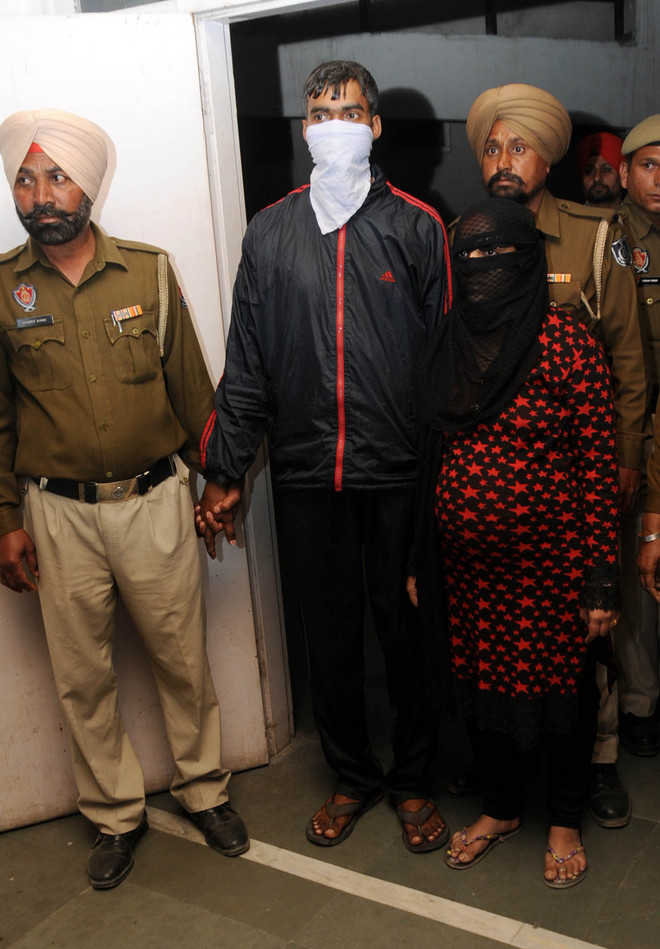
Two years after he kidnapped and murdered an Airman, chopping his body into 100 parts and stuffing these into polythene bags, a Bathinda court today awarded the death sentence to IAF Sergeant Sailesh Kumar. 

“To be hanged by the neck till he is dead,” Additional Sessions Judge (ASJ) Kanwaljit Singh Bajwa pronounced the sentence. Sergeant Kumar’s wife Anuradha Patel, eight months’ pregnant at the time of the murder, was sentenced to five years’ rigorous imprisonment for destruction of evidence. The ASJ observed the accused, a member of the armed forces, should have shown courage in some other field, “in place of butchery”. He said: “It would be a mockery of justice and the conscience of society would be shocked, if death penalty was not awarded to him as his act was abhorrent and dastardly.

“This is surely a case which falls within the category of rarest of rare cases.” 

Image result for IAF Sergeant Sailesh Kumar
The couple in custody for the murder of Indian Air Force corporal Vipan Shukla (inset) in Bathinda on Tuesday.
Photo: Pawan Sharma
According to the prosecution, the victim’s wife told the police that Vipin left house at the Bhissiana Airbase on February 8, 2017, but did not return. She and her father-in-law embarked upon a search. On February 21, they overheard two youngsters saying stench was emanating from the Sergeant’s residential quarters and informed the police. Evidence regarding the motive behind the murder was, however, not placed before the court.

CRIME MOST FOUL
Sergeant Sailesh Kumar kidnapped and murdered an Airman, chopped his body and stuffed parts into bags


An abhorrent and unjust device: on death penalty (Opinion)

MARCH 15, 2019 00:02 IST
UPDATED: 

Retention of the death penalty utterly undermines India’s moral foundations

On March 5, a three-judge bench of the Supreme Court delivered verdicts in three different death penalty cases. In two of those the court entirely exonerated the suspects, while in the third it not only found the accused guilty of murder, but also deserving of capital punishment. Individually read, the judgments typify the deep penological confusion that pervades India’s criminal justice system. Collectively, the cases demonstrate how arbitrary the death penalty is, how its application is mired by a belief in conflicting values, and how the fundamental requirement of precision in criminal law has been replaced by a rhetorical cry for avenging crime by invoking the “collective conscience” of society.

Conjecture and farce
In the first of the cases, Digamber Vaishnav v. State of Chhattisgarh, two persons were convicted of murdering five women and were sentenced to death in 2014. A year later, the Chhattisgarh High Court affirmed these sentences. But the chief testimony, which formed the backbone of the prosecution’s case, was that of a nine-year-old child, who was, shockingly, not even an eye-witness to the crime. This, the court therefore ruled, was effectively a conviction premised on surmise and conjecture.

Ankush Maruti Shinde v. State of Maharashtra, the second of the cases, saw a gut-wrenching series of events being reduced to macabre farce. In 2006, a trial court found six persons guilty of rape and murder and sentenced each of them to death. A year later, the Bombay High Court confirmed the finding of guilt, but commuted the sentences imposed on three of the individuals to life imprisonment. However, in 2009, the Supreme Court not only dismissed the appeals filed by those sentenced to death, but also, astonishingly, enhanced the penalties of the three persons whose sentences had been commuted by ordering that they too be punished with death. In doing so, the court relied on a 1996 verdict, in Ravji v. State of Rajasthan, where it had ruled that in determining whether to award the death penalty “it is the nature and gravity of the crime” alone that demand consideration. Although in May 2009, the Supreme Court had declared its earlier ruling in Ravji incorrect, by holding that even in those cases where the crime is brutal and heinous the criminal’s antecedents, including his economic and social background, must have a bearing on the award of the sentence, it took until October last year for the court to recall its order sentencing the six persons to death.

During this time, as the court records, “The accused remained under constant stress and in the perpetual fear of death.” What is more, one of them, who was later found to be a juvenile at the time when the alleged crime was committed, was kept in solitary confinement. He was not allowed to meet any of the other prisoners and was only allowed an occasional meeting with his mother. For their troubles — for having spent more than a decade on death row despite having committed no crime — the bench ordered that the state pay each of them a sum of ₹5 lakh. But while the court was quick to apportion blame on the prosecution, it didn’t so much as mention its own errors and its own proclivity to mirror the mentality of a mob.

A ‘rarest of rare’ case
Yet, we might have been forgiven for thinking that the court’s experience in hearing Digamber Vaishnav and, especially, Ankush Maruti Shinde may have made it more circumspect in upholding death sentences. After all, if these decisions had shown us anything, it was that the judicial process is far from inerrant. But the collective conscience of society, represented through the court’s capital punishment jurisprudence, it appears, is still alive and kicking. For in the third of the cases, in Khushwinder Singh v. State of Punjab, it not only affirmed the conviction of the accused, on charges of murdering six members of a family, but also gave its imprimatur to the award of the death penalty. The murders, the judgment holds, were “diabolical and dastardly” and the case fell into the “rarest of rare” categories where “there is no alternative punishment suitable, except the death sentence”.

The rarest of rare doctrine has its origins in Bachan Singh v. State of Punjab(1980). There, the court declared Section 302 of the Indian Penal Code, which prescribes the death penalty for murder, as constitutionally valid, but bounded its limits by holding that the punishment can only be prescribed in the rarest of rare cases. Since then, the court has repeatedly cautioned that capital punishment ought to only be decreed when the state can clearly establish that a convict is incapable of being reformed and rehabilitated. But, in Khushwinder Singh, the court does not place on record any such piece of evidence that the state was called on to produce. Indeed, the court does not so much as attempt to answer whether the accused was, in fact, capable of reformation or not. Instead, it merely endorses the death sentence by holding that there simply were no mitigating circumstances warranting an alternative penalty.
Victims of the system

That capital punishment serves no legitimate penological purpose is by now abundantly clear. There’s almost no empirical evidence available showing that the death penalty actually deters crime. If anything, independent studies have repeatedly shown the converse to be true. In the U.S., for instance, States that employ capital punishment have had drastically higher rates of homicide in comparison with those States where the death penalty is no longer engaged. In India, evidence also points to a disproportionate application of the sentence, with the most economically and socially marginalised amongst us suffering the most. The Death Penalty India Report (DPIR), released on May 6, 2016, by Project 39A of the National Law University, Delhi, for example, shows that 74% of prisoners on death row, at the time of the study, were economically vulnerable, and 63% were either the primary or sole earners in their families. More than 60% of those sentenced to death had not completed their secondary school education, and 23% had never attended school, a factor which, as the report states, “points to the alienation that they would experience from the legal process, in terms of the extent to which they are able to understand the case against them and engage with the criminal justice system.” Just as distressingly, 76% of those sentenced to death belonged to backward classes and religious minorities, including all 12 female prisoners.

In the face of this invidiously prejudiced application, the retention of capital punishment utterly undermines the country’s moral foundations. Over the course of the last decade, the Supreme Court may well have expanded the rights of death row prisoners: delays by the President in disposing of mercy petitions now constitute a valid ground for commutation; review petitions filed by death row convicts now have to be mandatorily heard in open court. But as the judgments delivered on March 5 reveal, the very preservation of the death penalty creates iniquitous results. Cases such as Ankush Maruti Shinde, where the accused, as the judgment records, were very poor labourers, “nomadic tribes coming from the lower strata of the society,” ought to make it evident that the death penalty is an abhorrent and unjust device.

Not only are wholly irrational criteria applied to arrive at dangerously irreversible decisions, the law’s application is made all the more sinister by invariably imposing these standards on the most vulnerable members of society. The Constitution promises to every person equality before the law. But capital punishment renders this pledge hollow. It legalises a form of violence, and it closes down, as Judith Butler wrote, expounding Jacques Derrida, “the distinction between justice and vengeance,” where “justice becomes the moralised form that vengeance assumes.”

Suhrith Parthasarathy is an advocate practising at the Madras High Court

HC upholds death in Theni rape case (Tamil Nadu)

TNN | Mar 14, 2019, 12.03 PM IST

MADURAI: The Madurai bench of the Madras high court on Wednesday upheld the death sentence by a trial court in Theni to a man who raped and murdered a college student and her male friend near Suruli fallls in Theni in 2011. In March 2018, the principal district and sessions judge, Theni sentenced the accused, Diwakar to death after the offences against him were proved. The verdict was referred before the division bench of justice R Subbiah and justice B Pugalendhi and the bench upheld the trial court’s verdict. 

Diwakar, now aged 30 years had committed the crimes when attempting to rob the couple after confronting them when they were spending time together near the falls, the prosecution held. He had also chopped off the limbs of the woman after raping her. The woman’s family had filed a missing complaint initially and five days later, both the bodies were found in the forest area. The Rayappanpatti police eventually arrested the accused and substantial circumstantial evidence proved him committing the crime. The accused, before the rape and murder had threatened another couple the same day in the same forest region and the man identified the accused after he came to know that a couple was murdered. “The brutality of the attack on the young and helpless girl, after forcibly raping her, would show the inhuman act of the accused. We are shocked by the savagery of the offence,” the division bench said and stated that the conduct of the accused shows that he is an extremist and would be a menace to the society. 

The division bench also noted that the accused had criminal antecedents and he once attacked a policeman with a sharp object when police attempted to arrest him for jumping bail in this case. Holding that the present case falls within the rarest of rare category propounded by the Supreme Court, the division bench upheld the trial court’s order. Earlier, before confirming the trial court verdict, the bench also reflected on mixed opinions on death sentence in the country. “Majority of citizens want the judicial system to deal offenders of rape and murder with an iron hand. They want the judiciary to take note of the plight and trauma that would have been undergone by the families of the victims,” the court said and observed that there is also a contrary opinion which requires the judiciary to soft pedal on the issue by resorting to reformative theory and take a humanitarian approach.

Death only when life term inadequate: Supreme Court

Amit Anand Choudhary
TNN | Mar 13, 2019, 03.34 AM IST

NEW DELHI: Holding that the death sentence should be awarded for heinous crimes only when life imprisonment appears to be wholly inadequate, the Supreme Court on Tuesday spared a man from the gallows and sentenced him to 25 years in jail for raping and killing a minor girl in 2015. A bench of Justices NV Ramana, M M Shantanagoudar and Indira Banerjee convicted a school bus driver who had raped and murdered the child in Jabalpur and refused to give credence to some discrepancies in the statement of witnesses. 

It said traditional dogmatic hypertechnical approach has to be replaced by a rational, realistic and genuine approach for administering justice in a criminal trial. The accused had taken the ground that there were procedural lapses on the part of police and his alleged confession, which led to the recovery of the victim’s body, was liable to be rejected as the panchnama was drawn at the police station and not at the spot from where the body was recovered. He said the prosecution’s case mainly rests on the last-seen circumstances, but the said circumstance has not been duly proved. 

Benefit of doubt must not be fanciful: SC

The court, however, rejected his plea and said there was sufficient evidence to prove his guilt and upheld the trial court and HC’s order of conviction. But the bench commuted the punishment to 25 years’ imprisonment without remission. “As has been well-settled, life imprisonment is the rule to which the death penalty is the exception. The death sentence must be imposed only when life imprisonment appears to be an altogether inappropriate punishment having regard to the relevant facts and circumstances of the crime,” the bench said. Rejecting the plea of the accused for granting him the benefit of the doubt, the bench said courts are not obliged to make efforts either to give latitude to the prosecution or loosely construe the law in favour of the accused. “In our considered opinion, all the circumstances relied upon by the prosecution are proved beyond reasonable doubt and consequently the chain of circumstances is so complete so as to not leave any doubt in the mind of the court that it is the accused and accused alone who committed the offence in question. 

It is worth reiterating that though certain discrepancies in the evidence and procedural lapses have been brought on the record, the same would not warrant giving the benefit of the doubt to the accused/appellant. It must be remembered that justice cannot be made sterile by exaggerated adherence to the rule of proof, inasmuch as the benefit of doubt given to an accused must always be reasonable, and not fanciful,” the bench said.

Wednesday, May 29, 2019

SC Commutes Death Penalty, Sentences Child Rapist To 25 Years Without Remission (Madhya Pradesh)

March 12, 2019

The Supreme Court on Tuesday commuted the death sentence of a man held guilty of committing rape of a five-year-old girl and then killing her in 2015 in the Satna district of Madhya Pradesh. The apex court has sentenced the man to 25 years in jail without remission.

Earlier, the trial court had sentenced Sachin Kumar Singhraha to death, which was upheld by the Madhya Pradesh High Court. Challenging the orders, counsel for the Singhraha had contended that he was sentenced on the basis of circumstantial evidence and the police had failed to establish his guilt beyond doubt. He said the lower courts had not followed SC framed guidelines while awarding the death penalty.

In 2016, a bench headed by then CJI T S Thakur had stayed the death sentence.

—India Legal Bureau

Madhya Pradesh: The Indian state with most death row cases


Critics say the death penalty often targets marginalised groups and warn of an unfair justice system.

by Omkar Khandekar, 12 Mar 2019


Madhya Pradesh, India - Last July, 34-year-old rickshaw driver Rajkumar Pol was accused of sexually abusing a four-year-old girl he used to take to and from school in his home town of Katni, in the central Indian state of Madhya Pradesh. When confronted by his employer, "he didn't look worried at all", said Pol's wife, Sulochana Kol, who believed her husband. She currently lives and works at a dairy farm with her in-laws. "He said he didn't do it … How could he do it when we have a young daughter ourselves?" State police soon arrested Pol. He couldn't afford a lawyer, so was appointed legal aid two days before the trial began on July 23.

The Katni trial court scheduled all-day, back-to-back hearings for three days. BM Singh Rathore, who represented Pol, complained that he was hardly given time to prepare, which limited his ability to cross-examine witnesses. "But the court said, 'you must go on,'," said Rathore. Pol, who maintained his innocence, was found guilty of raping the girl and was sentenced to death. 

Advocate BM Singh Rathore does not believe his client got a fair chance [Omkar Khakendar/Al Jazeera]
In the absence of eyewitnesses, the verdict cited injuries around the child's private parts and testimony of her aunt, whom she had confided in. In 2018, 22 criminal cases in Madhya Pradesh, including Pol's, resulted in the death penalty - the highest across India that year. Twenty-one defendants were accused of sexually assaulting minors. Many of these trials were completed quickly - the defendants were convicted in days, at most weeks.Indian Prime Minister Narendra Modi has praised the speed of sentencing as evidence of his efforts to ensure women's safety, "Rapes used to occur earlier as well," Modi said in a speech in January. "But today death penalties are ... within three days, seven days, 11 days and one month."

By the end of 2018, 426 prisoners were on death row. Executions are rarely carried out in India and only three have been recorded since 2008. But critics are worried over the rising use of the death penalty. "If you look at the statistical data, most of those on the death row are extremely poor, with very little or no education and belong to India's most marginalised groups," said Ankita Sarkar, associate litigator at Project 39A, a New Delhi-based research group. "The quality of legal representation that prisoners of death row receive is very often abysmal. These extremely short trials make for a terrible quality of justice especially in a system where fabrication of evidence and suppression of exculpatory evidence is rampant. "India's stand to retain the death penalty when the world is moving to abolish it thus ends up perpetuating a lot of prejudices and biases," she added. "States like Madhya Pradesh, in this context, starts to look like the Texas of India."

Al Jazeera recently interviewed legal experts and prosecution and defence lawyers involved in cases in Ujjain, Katni, Datia and Gwalior, all of which were fast-tracked in the trial courts. According to several of these individuals, the eagerness to dispense justice was a result of media clamour, legal reforms and a systemic push for the maximum punishment - often at the cost of due process.

Awarded points for swift justice

In January 2018, the gang rape of an eight-year-old girl in Kathua, in the state of Jammu and Kashmir, renewed focus on sex crimes in India. In April, the government of Madhya Pradesh passed an order - later codified into lawacross India - to make the sexual abuse of minors punishable by death. In May, the Supreme Court instructed trial courts to wrap up hearings within two months. Around the same time, Rajendra Kumar, Madhya Pradesh public prosecutor, introducedan online performance assessment system for lawyers representing the state in trial courts. 

Each month, prosecutors were rewarded for the number of witnesses they examined and the number of convictions they secured. A death penalty verdict would get them 1,000 points, while life imprisonment earned 500 points. The best performers were recognised by the chief minister every month and regular high achievers stood a chance at being promoted. Acquittals meant losing points. Pushpendra Garg, district prosecution officer (DPO) in Datia, said the points system motivated his team. Garg was the lead prosecutor in a case that saw a 24-year-old man accused of sexually assaulting a six-year-old sentenced to life in prison last May, following a three-day trial. "Our conviction rate has increased to 60 percent compared to 40 percent the previous year. We're even appealing against acquittals in higher courts more," he told Al Jazeera.

More appeals mean more points. The push to secure the death penalty came from Kumar, the Directorate of Prosecution director, said Abdul Naseem, DPO in the city of Gwalior. He recalled an exchange he had with Kumar after a 26-year-old from Gwalior was arrested last June for the alleged rape and murder of a six-year-old. "Will the death sentence happen?" Kumar asked Naseem. "It's likely. We're trying," Naseem replied. "It should," Kumar said, according to Naseem. "Try harder."

The trial at Gwalior resulted in a death sentence, in less than three weeks. The High Court upheld the verdict despite the fact police had, said the prosecutor, planted an eyewitness to strengthen their case. According to defence lawyer Ravindra Singh Gurjar, nearly 17 lawyers from the state legal aid pool had refused to represent his client. "I too didn't want to but then I thought, how can I determine the guilt of a person without a trial?" As the trial began, he noticed that the prosecution used the media to stoke public anger. "Every day, the developments in the trial were reported in newspapers with the photograph of the accused and that of a noose. It was a closed-door trial and I wasn't speaking to the media. The information could only be given by the state prosecutors," he told Al Jazeera.

"I've often seen people framed by the police as accused. The motivation can be personal or there can be political pressure".
RAKESH SHARMA, CRIMINAL LAWYER

In Madhya Pradesh, nearly 2,500 rapes against minors were recorded in 2016.  India has a poor record of convicting those accused of sexually abusing children - around 28 percent were convicted in 2016. Legal experts say the rising use of the death penalty, especially in cases that are fast-tracked, is worrying. "I've often seen people framed by the police as accused," said Rakesh Sharma, a criminal lawyer from Gwalior with 46 years of experience. "The motivation can be personal or there can be political pressure. In crimes involving a death sentence, it is the responsibility of a court to appoint an experienced, competent lawyer from the legal aid cell. They often don't." 

According to the Supreme Court judgement in the case of Bachan Singh vs the State of Punjab in 1980, the death penalty is meant to be applied in the "rarest of rare" cases. But in recent years, the court has observed that it was being imposed "arbitrarily and freakishly", and that "principled sentencing" had become "judge-centric". In a 2008 study, Amnesty International called for a moratorium on the death penalty, citing the risks it poses to marginalised communities. A few years ago, New Delhi-based research group Project 39A examined death penalties handed out between 2000 and 2015 and found that less than five percent were upheld in the Supreme Court and almost 30 percent of death row prisoners were eventually acquitted.

Supreme Court judge Madan B Lokur claimed in 2016 that death row prisoners often failed to get quality representation, saying: "Legal aid in India is nothing but a joke." Kumar, the director-general of prosecution in Madhya Pradesh, however, said the speed of sentencing was a sign of efficiency. "You might say that [conviction in] five days is fast but we had given all possible evidences," he told Al Jazeera. "The high court has already confirmed [death sentences in] seven cases. Three to four cases were commuted to life imprisonment. But it never said the trials conducted were faulty." However, according to the Indian Criminal Procedure Code, the presiding judge is required to look into the circumstances of the accused and their life history, beyond the details of the crime, before imposing a death penalty. In most of the cases in Madhya Pradesh in 2018, death sentences were handed down on the same day as the verdict with little consideration to the accused person's social or criminal background.

Amit Shukla, assistant director general of prosecution in the state, added: "But the public has to have faith in system," he said. "If there's crime, there has to be punishment ... The government has made a law of death penalty. If we are following it, how's that wrong? If the person is innocent, he is relieved in the higher courts. Life goes on." Last October, the Jabalpur High Court in Madhya Pradesh commuted the death sentence of Rajkumar Pol, the rickshaw driver, to 22 years in prison. His crime was "vicious, condemnable and reprehensible … [but] nothing is available on record to suggest that he cannot be useful for the society." Six months on, his wife Sulochana visits him in prison every few weeks. "Even today he says he's innocent," she said. "We're thinking of moving to the Supreme Court. Maybe we'll get justice then."